
AVAV Stock Futures: How to Trade AeroVironment With Leverage

 Prefer us on Google


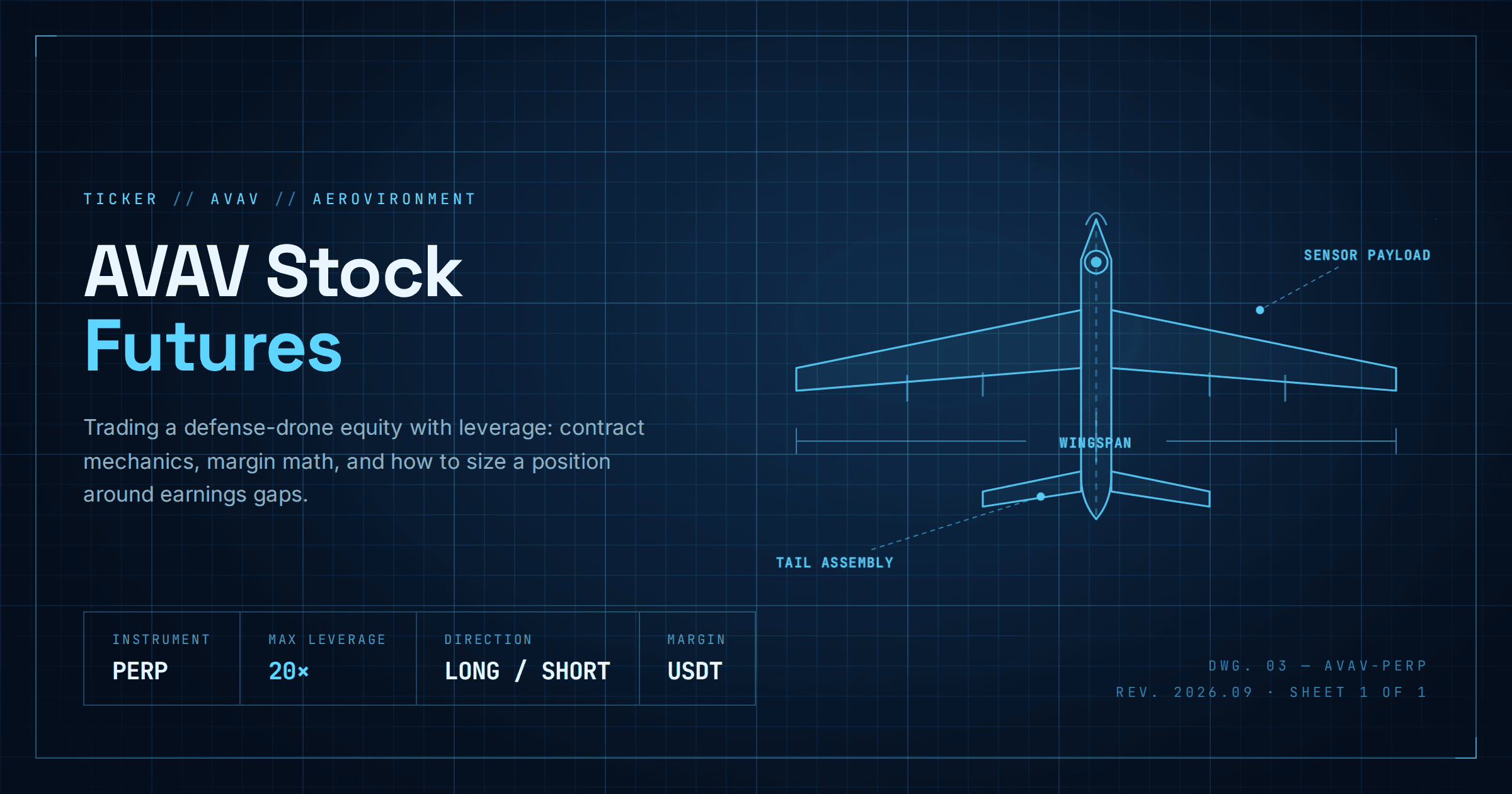
AVAV stock closed at $140.80 on September 9, 2026 — down 5.36% on the day AeroVironment reported record quarterly revenue — and then traded up 3.90% to $146.30 after the bell. If you held shares in a standard brokerage account, you watched that reversal happen without being able to act on it. That gap between when news breaks and when the market is open is the practical reason traders use AVAV stock futures: a perpetual contract on AeroVironment that trades around the clock, prices long or short with equal ease, and lets you size a position with leverage instead of full cash. This guide covers what the contract is, how margin and liquidation actually work on a name this volatile, what funding costs, how PnL is calculated, and where the risk management has to be tighter than it would be on Bitcoin.
AVAV stock right now: A 66% drawdown and a record backlog
The setup is unusual, and it explains the volatility. AeroVironment's fiscal Q1 2027 results, released September 9, 2026, were the strongest in the company's history: revenue of $480.5 million against a $456.1 million consensus, adjusted diluted EPS of $0.59 versus $0.25 expected, bookings of $683 million (up 71% year over year), and funded backlog of $1.5 billion, up 37%. The quarter included a $464.8 million U.S. Army award for the E-HEL high-energy laser — the company's first production contract in directed energy — and a $50 million international LOCUST counter-drone order.
The stock fell anyway. At $140.80, AVAV sits roughly 66% below its 52-week high of $417.86, against a 52-week low of $135.20 set in the same stretch. Twenty analysts carry an average 12-month target of $225.77, per stockanalysis.com data as of September 9, 2026.
Two things follow from that. First, the disagreement between a record backlog and a collapsing share price is exactly the condition that produces large two-way moves — the September 9 session alone traded a $139.77 to $150.05 range, 7.4% low to high. Second, that volatility is what makes leverage on AVAV dangerous in a way most traders underestimate, which is the thread running through the rest of this article.
How AVAV stock futures work, and why traders use them
An AVAV perpetual futures contract is an agreement to exchange the price difference on AeroVironment shares. You never own stock. There is no settlement date, no expiry roll, no shareholder rights, no vote, and no claim on any dividend. What you get is direct exposure to the price, in either direction, denominated in USDT.
Three properties matter:
- No expiry. A traditional futures contract expires and has to be rolled. A perpetual does not, which is why it needs the funding mechanism described further below to stay tethered to the underlying.
- Long and short are symmetric. Going short AVAV requires no borrow, no locate, and no stock-loan fee. You open a sell position the same way you open a buy position. For a name 66% off its high with a contested narrative, that symmetry is the point.
- It trades when NASDAQ does not. On WEEX, the AVAV/USDT perpetual was quoting 142.60 USDT as of September 10, 2026 — between the $140.80 regular-session close and the $146.30 after-hours print from the previous evening. That is the contract doing its job: pricing the earnings reaction while the cash market was shut.
That last point is also the first real risk. When the underlying market is closed, a stock perpetual is priced by order flow on the exchange, not by arbitrage against a live cash quote. It can drift from where the shares will actually open. Traders who assume a perpetual is a perfect mirror of the stock get taught otherwise at the Monday open.
Leverage and margin: When does an AVAV position liquidate?
Leverage on a perpetual is a function of how much margin you post against the notional size of the position. WEEX lists AVAV/USDT at up to 20× leverage. Take a concrete case at 10×.
Post $1,000 of margin at 10× and you control roughly $10,000 of notional — about 70 AVAV at 142.60, or $9,982. Your margin is 10% of the position, so a 10% adverse move consumes it. For a long, that is a fall to about $128.34. In practice liquidation triggers earlier, somewhere near $129 to $130, because maintenance margin and fees are deducted before the account reaches zero.
Now apply that to the actual tape. On September 9, AVAV traded a 7.4% intraday range. At 20× — the maximum on this contract — the liquidation buffer is roughly 5%. A position opened anywhere in the upper half of that day's range would have been closed out before the after-hours recovery, on a day the company reported record results. The trade thesis was right. The size was wrong.
This is where margin mode matters. Isolated margin caps the loss at the margin assigned to that one position; cross margin draws on the whole account balance to defend it, which delays liquidation but exposes everything else you hold. Adding margin to an open position moves the liquidation price further away — the mechanics and the formula are set out in the WEEX guide on how adjusting margin affects your liquidation price. Withdrawing margin does the reverse.
The practical rule for a stock perpetual on a name with AVAV's realized volatility: pick the leverage from the distance to your invalidation level, not from the maximum the exchange allows. If your thesis breaks at $128, a 10× long entered at $142.60 has essentially no room, because liquidation lands on top of your stop.
-- Price
What the funding rate costs you on an AVAV position
Funding is the mechanism that keeps a no-expiry contract anchored to the underlying. It is a periodic payment between long and short holders, not a fee paid to the exchange. When the perpetual trades above the index price, funding is positive and longs pay shorts; when it trades below, shorts pay longs. The contract page shows the current rate alongside a countdown to the next settlement, and only traders holding a position at the settlement timestamp pay or receive.
Two consequences worth internalizing. On a directional day trade closed inside a single funding interval, funding is irrelevant. On a multi-week position — the horizon most people have in mind when they take a view on a defense contractor's backlog — a persistently positive rate is a real drag that compounds against a long, and can quietly turn a correct call into a flat result.
The inverse is the more interesting case. Crowded longs in a perpetual push funding positive, which means a short is being paid to hold. After an event like the September 9 earnings reaction, a look at whether funding has flipped tells you something about positioning that the price chart alone does not.
Order types, PnL, and where to put the stop on AVAV
PnL on a linear USDT-margined contract is straightforward: position size in shares, multiplied by the difference between entry and exit, minus fees and any funding paid. The 70-contract long from the earlier example, entered at 142.60 and closed at the session high of $150.05, returns $7.45 × 70 = $521.50 — a 52% gain on $1,000 of margin. Closed instead at the 52-week low of $135.20, it loses $7.40 × 70 = $518, or 52% of margin. Leverage does not change the thesis; it changes what a normal day's range does to your account.
Execution mechanics, in the order you use them:
- Market order — fills immediately at the best available price. Appropriate for exiting, expensive for entering a thin book during a volatile print.
- Limit order — fills at your price or better, or not at all. The default for entries when you are not chasing.
- Stop-loss — a trigger price that closes the position when the market reaches it. Set it where the trade idea is wrong, not at a round number that feels tolerable.
- Take-profit — the mirror image, closing at a target. Attach both at entry rather than promising yourself you will do it later.
The full order flow, from selecting the contract to closing the position, is walked through step by step in the WEEX futures trading guide.
The mistake experienced traders watch for on stock perpetuals specifically: setting a stop inside the overnight gap. AVAV's underlying stops trading at the closing bell and reopens with a fresh price. A stop placed 3% away on a Friday evening is not a 3% stop — it is a stop that a Monday gap can jump straight through, filling well below the trigger. On instruments with a closed underlying, either size the position so a gap is survivable, or hold no leveraged exposure through the weekend.
AVAV futures vs BTC and ETH futures: Sizing it right
The most useful comparison here is with the crypto majors on the same platform, because the contract terms tell you how the exchange itself reads the risk.
As of September 10, 2026, WEEX quotes BTC/USDT perpetuals at 77,963.7 and ETH/USDT perpetuals at 2,461.52, both available at up to 400× leverage. AVAV/USDT is capped at 20×. That is a twentyfold difference in permitted leverage, and it is not a statement that AVAV is more volatile than Bitcoin — day to day it usually is not. It reflects structure: BTC and ETH trade continuously in deep books across dozens of venues, while a tokenized equity perpetual references an underlying that is closed most hours of the week and whose price can reset on a single earnings release or contract award.
So the sizing logic differs. On BTC, the binding constraint is usually volatility, and leverage is chosen against an expected daily range. On AVAV, the binding constraint is event risk and gap risk. A defense contractor's price can move 20% on a procurement decision that arrives with no warning, and no stop protects you across a closed session.
A workable discipline for AVAV stock futures: risk a fixed percentage of account equity per trade rather than a fixed leverage multiple, set the stop at the technical or fundamental invalidation point, then derive the position size from the distance between entry and stop. If that math produces a position smaller than feels worth the effort, that is the answer, not a reason to raise leverage. And avoid holding leveraged AVAV exposure into an earnings date unless the gap is the trade — as September 9 demonstrated, a record quarter and a 5% decline are entirely compatible outcomes.
Trade AVAV stock futures on WEEX, alongside crypto majors, from a single USDT margin balance.
FAQ
1. Can you actually trade AVAV stock 24/7?
You can trade an AVAV perpetual futures contract around the clock, but not the underlying shares. The contract prices continuously; NASDAQ does not. When the cash market is closed, the perpetual is driven by exchange order flow and can diverge from where the stock last traded, and from where it will open.
2. What is the maximum leverage on AVAV stock futures?
WEEX lists AVAV/USDT at up to 20×, against up to 400× for BTC and ETH perpetuals as of September 10, 2026. The lower cap on a tokenized equity reflects gap and event risk in the underlying, not a view that AVAV is more volatile intraday.
3. Do I own AeroVironment shares if I trade the perpetual?
No. A perpetual is a price-exposure contract settled in USDT. There is no share ownership, no voting right, and no dividend claim.
4. How is PnL calculated on an AVAV futures position?
Multiply the position size in shares by the difference between entry and exit price, then subtract trading fees and any funding paid while the position was open. A 70-contract long entered at 142.60 and closed at 150.05 gains $521.50 before costs.
5. Why did AVAV stock fall after record earnings?
AeroVironment beat on revenue and EPS on September 9, 2026, and grew bookings 71%, but the stock declined 5.36% to $140.80 before recovering 3.90% in after-hours trading. Guidance was maintained rather than raised, and the shares had already fallen roughly 66% from their 52-week high — a setup where strong results are measured against positioning rather than against consensus alone.
6. Is shorting AVAV easier with futures than with shares?
Mechanically, yes. A short perpetual position requires no share borrow, no locate, and no stock-loan fee, and it is opened the same way as a long. The risk profile is not easier: a short carries theoretically unlimited loss on an upside gap, and AVAV has an average analyst target well above the current price.
Risk Warning
Leveraged futures trading carries substantial risk and can result in the partial or total loss of your margin. AVAV stock futures compound that with equity-specific hazards: the underlying shares stop trading at the closing bell, so weekend and overnight gaps can move the contract straight through a stop-loss level and produce a fill far worse than the trigger price. AeroVironment is a defense contractor whose revenue depends on government procurement decisions, and a single contract award, cancellation, or budget change can reprice the stock double digits without warning — the company reported a net loss of $202.82 million on a trailing-twelve-month basis as of September 2026 and trades roughly 66% below its 52-week high. At 20× leverage, a 5% adverse move is a full liquidation, and AVAV traded a 7.4% range on September 9, 2026 alone. Tokenized equity perpetuals also carry liquidity risk in thinner books, funding costs on held positions, and counterparty and regulatory risk. Nothing here is investment advice. Size positions so that the worst realistic gap is survivable, and never commit margin you cannot afford to lose.
This content is provided for general informational purposes only and doesn't constitute financial, investment, legal, or tax advice. Any events, rewards, online promotions, or related information mentioned herein should not be considered a recommendation, solicitation, or invitation to purchase, sell, trade, or otherwise deal in any crypto assets. Crypto assets are highly volatile and may result in loss. The availability of WEEX services, products, and related events may vary by region. You are responsible for ensuring that your participation is in accordance with applicable local laws and regulations.
You may also like
Is The US Becoming The Crypto Capital? Brad Garlinghouse's Bold Predictions Explained
Nike S&P 100 Exit: What the Removal Means for NKE Holders
Trump's "Hundreds of Billions" Stock Claim: The Trader's View
CLARITY Act Enters a Critical Window: What the September 15 Senate Vote Actually Means

What Is Tangem Wallet? A Complete Beginner's Guide

CyberLeek Crypto: The GTA 6 Token's Exit Liquidity Problem
How to Install and Set Up MetaMask (2026 Updated Guide)
Dell Earnings: $95B AI Backlog Now Dwarfs Its Own Guidance
Fable 5.1: What Anthropic's New Model Means for AI Tokens
"We're Back": Why Strategy's Return to Bitcoin Buying Is Moving More Than Just MSTR Stock

How to Transfer Funds from P2P Wallet to Futures in Pakistan: A Step-by-Step Guide
SpaceX Stock Price Holds Near $141: Why Isn't a $100 Billion Spaceport Plan Moving It?
Salesforce Stock Price Targets Are Rising Fast: What Wall Street Actually Sees

Marvell Stock (MRVL) Beat Earnings and Raised Guidance: Why Did It Fall Anyway?

What Is the WEEX Mini App? A Lightweight Way to Trade Inside Telegram
CRMON After Salesforce's 23% Post-Earnings Surge: The Catch
XST Coin Price Crosses Into Deep Capitulation Territory: What a 90%+ Decline Actually Signals
A Breakup Became "我的女友景甜" Token in Hours: What That Says About Crypto's Attention Economy
PONS After 200% Rally: Overvalued or Still a Growth Story?
Micron (MU) Earnings Date: When Q4 FY2026 Reports and What to Watch
Bank Account Freeze Risk for Crypto Traders in Pakistan 2026
Is Crypto Legal in Pakistan? PVARA Rules Traders Must Know
PKR to USDT Rate: How to Spot a Bad P2P Spread in Pakistan
Why USDT Still Dominates Crypto Buying in Pakistan Today
Crypto Tax in Pakistan: What FBR Rules Mean for PKR Traders
How to Buy Crypto with PKR on WEEX P2P in Pakistan?
Bitcoin Price Over 10 Years: Historical Recap and Long-Horizon Outlook
How to Buy USDT with JazzCash in Pakistan Safely in 2026
JazzCash Crypto Guide: How PKR-to-USDT P2P Payments Work in Pakistan
Why Is DGrid AI (DGAI) Trending After Its Exchange Debut?
Is The US Becoming The Crypto Capital? Brad Garlinghouse's Bold Predictions Explained
Nike S&P 100 Exit: What the Removal Means for NKE Holders
Trump's "Hundreds of Billions" Stock Claim: The Trader's View
CLARITY Act Enters a Critical Window: What the September 15 Senate Vote Actually Means
What Is Tangem Wallet? A Complete Beginner's Guide
CyberLeek Crypto: The GTA 6 Token's Exit Liquidity Problem


