
Crypto Futures Trading Explained: Leverage, Funding, Liquidation

 Prefer us on Google


Crypto futures trading lets you take a leveraged long or short position on an asset you never take delivery of — and the three numbers that decide whether you keep the money are your leverage, your funding cost, and your distance to liquidation. Most beginners learn the first one and discover the other two the expensive way. This guide walks the full chain in the order it actually hits your account: what a perpetual contract is, what your margin is really doing, the exact adverse move that triggers liquidation, what funding costs you per day of holding, how PnL nets out after fees, and which order and risk rules keep a position alive long enough to be right.
What crypto futures trading actually is — and how perpetuals differ
A futures contract is an agreement to settle the price difference of an asset, not to buy the asset. When you go long BTC futures, you never hold bitcoin. You hold a position whose value tracks bitcoin's price, funded by collateral you posted.
Traditional futures expire. Crypto's dominant instrument does not. A perpetual contract — the perp — has no expiry date, so the exchange needs another mechanism to keep the contract price tethered to spot. That mechanism is the funding rate, covered below, and it is the single most misunderstood line item in the product.
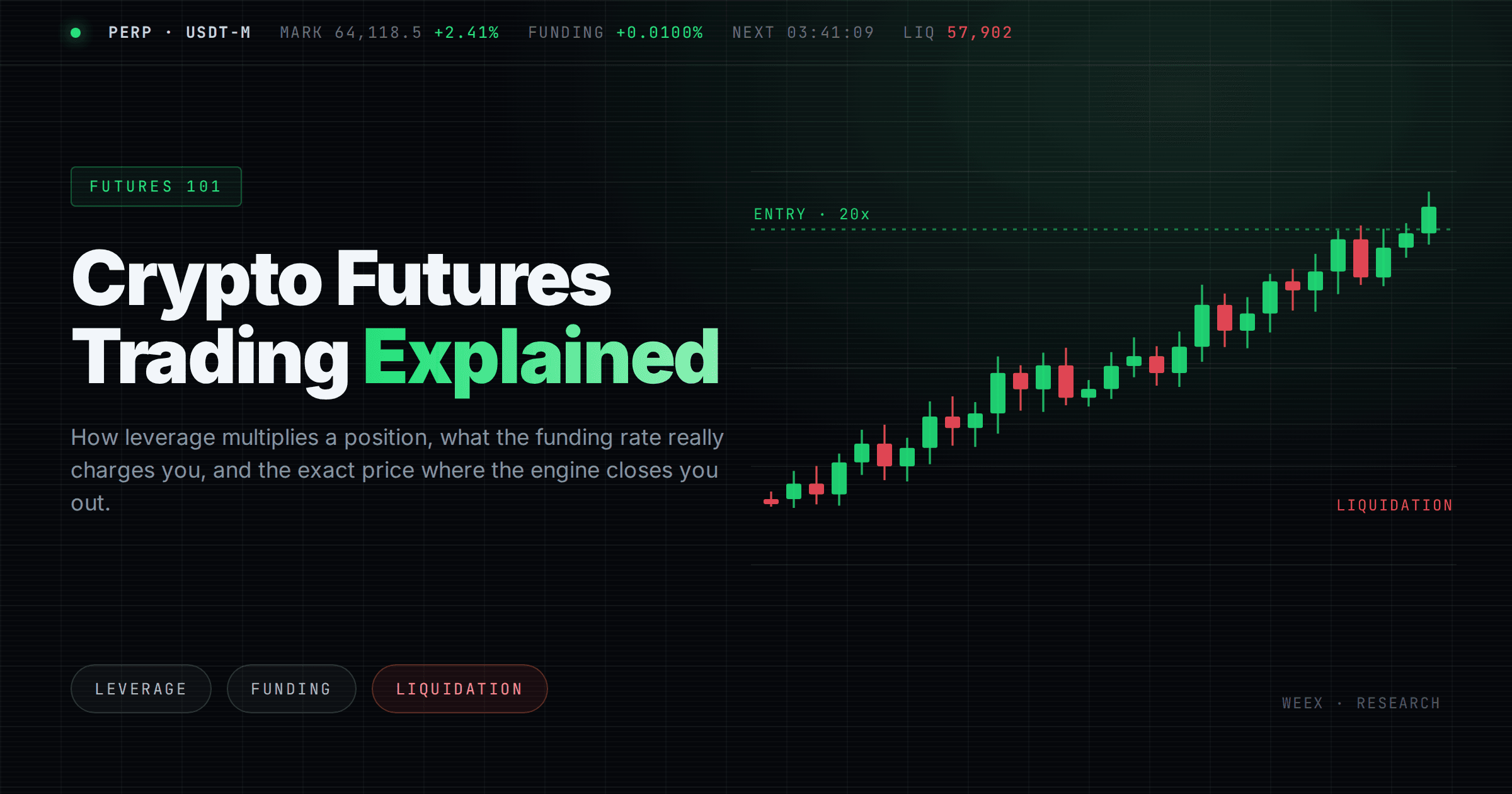
Two practical consequences follow from "no expiry":
- You can hold a directional position indefinitely, which sounds like freedom and is actually a recurring bill.
- There is no settlement date forcing convergence, so the contract can trade at a persistent premium or discount to spot while funding does the correcting.
Perps also let you short as easily as you go long. In spot markets, expressing a bearish view means selling something you own or borrowing it. On a perp, short is a single click and carries the same margin mechanics as long — with the funding sign flipped.
Leverage and margin: What your collateral is really doing
Leverage is a ratio between position size and posted collateral. At 10×, $1,000 of margin controls $10,000 of notional exposure. What most guides skip: leverage does not change your profit per dollar of price movement. A 1% move on $10,000 of notional pays $100 whether you posted $10,000 or $1,000. Leverage changes how much of your collateral that $100 represents — and how close the position sits to being closed for you.
Margin comes in two modes, and choosing wrong is a common early error:
- Isolated margin ring-fences a fixed amount of collateral per position. If it liquidates, you lose that amount and nothing else. Losses are capped and predictable.
- Cross margin lets your whole account balance backstop the position. Liquidation comes later because there is more collateral behind you, but a single bad trade can reach every dollar in the account.
The instinct that cross margin is "safer because it liquidates later" is backwards for anyone still learning. Later liquidation on a losing position means a larger realized loss, drawn from funds earmarked for other trades. Isolated margin with a deliberately sized position is the more conservative structure.
Maximum leverage also varies by asset, and the ladder is informative. On WEEX as of 10 September 2026, the BTC-USDT perpetual contract and the ETH perp both offer up to 400×, the SOL perpetual up to 300×, and a mid-cap like the WIF perp up to 200×. Read that ladder as a liquidity statement rather than an invitation: exchanges extend the highest leverage on the books deep enough to absorb a forced close without gapping. The number is a measure of the market's depth, not a recommendation for your position size.
How liquidation works, and the exact move that triggers it
Liquidation is not a penalty. It is the exchange closing your position while enough collateral remains to cover the loss, before the shortfall becomes theirs.
The arithmetic is simple enough to do in your head, and doing it before entry changes behavior more than any warning does. Ignoring fees, the adverse price move that liquidates an isolated position is roughly:
(1 ÷ leverage) − maintenance margin rate
With an illustrative maintenance margin rate of 0.5%, that produces:
- 5× — liquidated on a 19.5% adverse move
- 10× — liquidated on a 9.5% adverse move
- 20× — liquidated on a 4.5% adverse move
- 50× — liquidated on a 1.5% adverse move
- 100× — liquidated on a 0.5% adverse move
Put real prices against it. With BTC trading at 77,963.7 on WEEX on 10 September 2026, a 10× long is liquidated around 70,557 — a $7,406 move. At 400×, the entire buffer is under a quarter of one percent, which at that price is roughly $195. Bitcoin covers $195 in ordinary intraday chop, frequently within a single minute. That is the honest reading of maximum leverage: at the top of the ladder, the position is not a trade with a wide stop, it is a bet on the next few ticks.
Maintenance margin rates are not fixed either — they step up as position size grows through the exchange's risk limit tiers. A large position faces a higher maintenance requirement and therefore a shorter distance to liquidation than the same leverage on a small position. Traders who size up after a winning streak often find their liquidation price closer than the ratio alone suggested.
-- Price
Funding rates: The cost of holding a perpetual position
Funding is a periodic payment between longs and shorts, typically settled every eight hours. When the perp trades above spot, longs pay shorts. When it trades below, shorts pay longs. The payment pulls the contract price back toward the index.
The rate is charged on notional, not on your margin, and that distinction is where the damage hides. Work it through:
- A funding rate of 0.01% per eight-hour period is 0.03% per day, or about 10.95% annualized on notional.
- A hot market printing 0.05% per period is 0.15% per day — roughly 54.75% annualized.
- At 10× leverage, that 0.03% daily charge on notional is 0.3% per day against your posted margin. Hold for thirty days and funding alone has consumed about 9% of your collateral before the price has done anything.
The better way to think about a perp is as a carry instrument with a direction attached. A long held through a strongly bullish stretch is usually paying funding continuously, because the crowd is positioned the same way. Being right on direction and still finishing flat after a multi-week hold is not bad luck; it is the carry doing exactly what it is designed to do.
Funding also works as a positioning signal. Persistently elevated positive funding means longs are crowded and paying for the privilege — the condition that precedes long squeezes. Deeply negative funding says the same about shorts.
Long, short, and how futures PnL is calculated after fees
Unrealized PnL on a linear USDT-margined contract is straightforward: position size in contracts × (exit price − entry price) for a long, reversed for a short. The number people actually care about is return on margin, and that is where the costs bite.
A worked example, using the same BTC price above. Long $77,963.70 of notional at 10× leverage, so posted margin is $7,796.37. Price rises to $81,000:
- Gross PnL is $3,036.30 — a 38.9% return on margin from a 3.9% move.
- Round-trip taker fees at an illustrative 0.12% of notional cost $93.56, leaving $2,942.74, or 37.7%.
- Holding three days at 0.01% funding per period costs a further 0.09% of notional, or $70.17.
- Net PnL is $2,872.57, a 36.8% return on margin.
The friction consumed about 5.4% of the gross gain on a winning three-day hold. On a scalping cadence the proportion is far worse: at 20× leverage, a 0.12% round-trip cost equals 2.4% of your margin per trade, before the market moves at all. Ten trades a day and the fee line is the strategy.
Order types, stop loss and take profit: Building the exit before the entry
Order selection is a cost and slippage decision, not a preference.
- Market orders fill immediately at the best available price and pay the taker fee. Use them to exit when being out matters more than the price.
- Limit orders fill at your price or better and typically earn the maker rebate or a lower maker fee. Use them to enter.
- Stop-market triggers a market order at your stop price — it fills, but the fill price is whatever liquidity allows during the move that triggered it.
- Stop-limit triggers a limit order, which protects the price and can fail to fill entirely in a fast market. That failure mode is exactly when you needed the stop.
- Trailing stops follow price by a fixed distance or percentage, locking in gains without requiring you to watch.
Set take profit and stop loss at entry, in the same action that opens the position. The reason is behavioral rather than technical: the decision quality of a trader watching an open loss is measurably worse than the same trader deciding in advance, and leverage compresses the time available to reconsider.
One structural detail that catches people: a stop loss placed inside the liquidation distance is the only version that does anything. At 100× leverage with a 0.5% liquidation buffer, a 2% stop is decoration — the position is gone long before the stop is reached. Stop distance has to come first; leverage is then chosen to accommodate it, not the other way around.
Crypto futures strategies, and what each one is really charging you
Most published strategy lists describe entries. The more useful frame is what each approach pays to run.
- Directional swing trading holds days to weeks at low leverage, typically 2× to 5×. Its main cost is funding, so the holding period has to be justified against roughly 11% to 55% annualized carry depending on the market's temperature.
- Intraday momentum takes several positions per session at moderate leverage. Its main cost is fees and slippage, which scale with trade count, not with holding time.
- Hedging a spot portfolio shorts a perp against coins you hold, converting price risk into a funding cost. This is the one case where paying funding is the intended outcome rather than a leak.
- Basis and funding-rate trades hold spot long against a perp short to collect positive funding while staying delta-neutral. The direction risk disappears; execution risk, funding-sign reversal, and exchange counterparty risk do not.
Where traders actually lose money is rarely the entry signal. It is sizing up after wins until the maintenance margin tier steps against them, adding margin to a losing position instead of cutting it, and holding a leveraged perp through a weekend of thin liquidity where the funding clock keeps running and the order book does not.
Major-coin contracts vs altcoin contracts
The practical difference between trading a BTC perp and a mid-cap perp is not volatility — it is what happens to your order when you need out.
Major-coin contracts on the WEEX futures market carry the deepest books, the tightest spreads, and the most stable funding. Liquidation is more likely to fill near your liquidation price rather than well through it. Altcoin perps behave differently in the specific moment that matters: spreads widen during volatility, funding swings harder and flips sign more often, and a forced liquidation can walk through several price levels, so realized losses exceed the calculated liquidation distance.
This is why the leverage ladder narrows as you move down the market cap. The 400× available on BTC and ETH, 300× on SOL, and 200× on WIF as of 10 September 2026 tracks liquidity depth. A beginner is usually better served taking a smaller multiple on a major than a large multiple on a thin book — the loss distribution on the second is far fatter than the ratio implies.
Risk management rules that decide whether you last
- Size positions from your stop distance, not from the leverage the platform offers.
- Cap risk per trade at a fixed fraction of account equity, commonly 1% to 2%, so no single liquidation is structural.
- Prefer isolated margin until position sizing is a habit rather than a decision.
- Check the funding rate before entering a multi-day hold and treat it as a cost of the trade thesis.
- Never add margin to defend a losing position; that converts a bounded loss into an unbounded one.
- Recalculate your liquidation price after every size change, since the risk limit tier may have moved underneath you.
FAQ
1. What is crypto futures trading in simple terms?
It is trading a contract that tracks a cryptocurrency's price, using borrowed exposure, without owning the coin. You post collateral called margin, take a long or short position, and settle the price difference in USDT.
2. How much can I lose trading crypto futures?
With isolated margin, your loss is capped at the collateral assigned to that position. With cross margin, a single position can draw on your entire account balance. In fast markets a liquidation can fill worse than the calculated liquidation price, so losses can exceed the theoretical figure.
3. What leverage should a beginner use?
Low single digits. At 5× an adverse move of roughly 19.5% is required to liquidate, which leaves room for normal volatility. At 100× the buffer is about 0.5%, which most major coins cover in ordinary intraday movement.
4. Do I pay funding on every futures trade?
Only if your position is open at a funding settlement, typically every eight hours. Positions opened and closed between settlements pay no funding. Multi-day holds pay it repeatedly, and the charge is calculated on notional rather than on your margin.
5. What is the difference between a perpetual contract and a traditional futures contract?
A traditional futures contract has an expiry date and settles then. A perpetual has no expiry and uses periodic funding payments between longs and shorts to keep its price aligned with spot.
6. Can I lose more than my initial margin?
On a well-capitalized exchange with isolated margin, generally no — the position is closed while collateral remains. Extreme gap moves or a thin order book can still produce a shortfall, which is why maximum leverage on illiquid contracts is lower.
7. Is a stop loss enough protection with high leverage?
Not on its own. A stop only helps if it sits inside your liquidation distance, and stop-market orders can slip during the volatility that triggers them. Choose the stop distance first, then set leverage to fit it.
Risk Warning
Crypto assets are volatile and leveraged futures trading can result in the partial or total loss of your margin, in some cases within minutes. Leverage magnifies losses on the same scale as gains: at 100× leverage a 0.5% adverse move is sufficient to liquidate a position. Funding payments accrue on notional value every eight hours and can materially erode returns on multi-day holds even when your directional view is correct. During periods of high volatility or thin liquidity, liquidations may execute at prices worse than the calculated liquidation price, and order books on lower-cap contracts can widen sharply. Additional risks include exchange counterparty and custody risk, network or platform downtime during fast markets, and regulatory changes that may restrict access to derivatives products in your jurisdiction. Prices and contract parameters cited here were observed on WEEX on 10 September 2026 and change continuously. Nothing here is investment advice. Trade only capital you can afford to lose in full, and verify current contract specifications on the platform before opening a position.
This content is provided for general informational purposes only and doesn't constitute financial, investment, legal, or tax advice. Any events, rewards, online promotions, or related information mentioned herein should not be considered a recommendation, solicitation, or invitation to purchase, sell, trade, or otherwise deal in any crypto assets. Crypto assets are highly volatile and may result in loss. The availability of WEEX services, products, and related events may vary by region. You are responsible for ensuring that your participation is in accordance with applicable local laws and regulations.
You may also like
How to Trade U.S. Stocks Without a Brokerage Account Using USDT

MetaMask Transaction Stuck or Failed? Here's How to Fix It

How to Install and Set Up MetaMask (2026 Updated Guide)

Is Arbitrum (ARB) Worth Buying After Its 30% Rally? An Analysis About Utility, Supply and Risks
Can You Trade U.S. Stocks With 5 USDT? Here's the Real Math
SpaceX Stock Price Holds Near $141: Why Isn't a $100 Billion Spaceport Plan Moving It?
Marvell Stock (MRVL) Beat Earnings and Raised Guidance: Why Did It Fall Anyway?

Where Is XST Actually Trading Now? A Look at Volume Distribution After the Crash
NVDA Stock Jumps 7% After Earnings: Is $250 Next?
Why Is Raini Studios Token (RST) Up Today Despite Low Trading Volume?

Before You Buy CyberLeek: You Should Know CYBERLEEK Token Risks First
Is CyberLeek (CYBERLEEK) Safe? Price Crash and Key Token Risks Explained
CyberLeek Price Prediction 2026: Can CYBERLEEK Recover After the Crash?

Why Is CyberLeek Price Falling Today? CYBERLEEK Crash Explained
SEC Sends Crypto Custody Rule to White House: What the Review Means for Investment Advisers
NVDA Earnings Call Recap: Revenue Guidance, AI Demand and Key Takeaways
Hamster Kombat Is Down 97% From Its Peak: What Happened to Crypto's Biggest Web3 Onboarding Experiment?

Nvidia Earnings Report Today: Did NVDA Beat Revenue and EPS Estimates?
Did Nvidia Beat Earnings? NVDA Q2 Results and Stock Reaction Explained

How to Buy USDT with Easypaisa Using PKR in 2026
Easypaisa Crypto Guide: How to Use the Mobile Wallet for P2P Trading in Pakistan
How to Log In to MetaMask: Unlock, Troubleshooting and Recovery (2026)
WEEX Mini App Launch Rewards: Trial Funds, BTC Airdrops, and an iPhone 17 Pro Giveaway Explained
How to Buy USDT with JazzCash in Pakistan Safely in 2026
JazzCash Crypto Guide: How PKR-to-USDT P2P Payments Work in Pakistan
H/USDT After the Unlock: What Humanity Protocol’s New Supply Means for Traders
Why Is DGrid AI (DGAI) Trending After Its Exchange Debut?
XSolut Coin Extends Its Decline to 7 Straight Days: What Continued Selling Pressure Actually Signals
MORTY After Viral Meme Rally: Overvalued or Growth Story?
SPCX Stock Keeps Swinging Around Its $135 IPO Price : What the Lockup Schedule Still Ahead Actually Means
How to Trade U.S. Stocks Without a Brokerage Account Using USDT
MetaMask Transaction Stuck or Failed? Here's How to Fix It
How to Install and Set Up MetaMask (2026 Updated Guide)
Is Arbitrum (ARB) Worth Buying After Its 30% Rally? An Analysis About Utility, Supply and Risks
Can You Trade U.S. Stocks With 5 USDT? Here's the Real Math
SpaceX Stock Price Holds Near $141: Why Isn't a $100 Billion Spaceport Plan Moving It?
Contents
Popular coins
Latest articles


