
Nintendo Stock Futures: What Leverage Survives a 10% Gap

 Prefer us on Google


Nintendo stock is one of the strangest large-cap setups of 2026: revenue nearly doubled, the share price roughly halved. The Tokyo-listed ordinary shares (TSE: 7974) closed at ¥8,839 on Sep 4, 2026, against a 52-week range of ¥6,544 to ¥14,630, while the US ADR (NTDOY) closed at $13.09 on Sep 9, 2026 — down 5.83% that session and down 44.27% over twelve months, according to StockAnalysis data. If you are looking at Nintendo stock through a leveraged contract rather than a brokerage account, the interesting question is not the price target. It is whether your leverage setting can survive the kind of day this stock now routinely produces. This piece covers what moved the shares, why "nintendo stock" resolves to three different prices, how a stock perpetual contract works mechanically, and the specific leverage levels that Nintendo's own 2026 sessions would have liquidated.
Why Nintendo stock halved while its sales doubled
The fundamentals are not the problem. In the results published Feb 3, 2026, Nintendo reported net sales of ¥1,905.8 billion, up 99.3% year over year, operating profit of ¥300.3 billion (+21.3%) and net profit of ¥358.8 billion (+51.3%). Switch 2 had shipped 17.37 million units, with 37.93 million units of Switch 2 software and 14.03 million copies of Mario Kart World.
The market sold it anyway. Shares fell roughly 10% on Feb 4, 2026 on memory-shortage concerns, and again about 9% on May 11, 2026 — to ¥6,895, one of the worst performances in the Nikkei 225 that day — when Nintendo paired a Switch 2 price increase with weak guidance. The US price went from $450 to $500 (+11%) effective Sep 1, 2026, with increases of roughly 7% to 20% in Europe and Japan. Guidance for the current fiscal year came in at ¥370 billion of operating profit against a consensus near ¥480 billion, a 23% shortfall, on sales of ¥2.05 trillion (−11.4% year over year) and 16.5 million Switch 2 units versus 19.86 million the prior year.
The cause is upstream and has nothing to do with games: AI data-centre demand has absorbed the overwhelming majority of advanced memory capacity, and DRAM is now a first-order input cost for a console maker. Nintendo has flagged a nine-figure yen hit from memory prices and tariffs. The more important point for a trader is what this does to the character of the stock. Nintendo's five-year beta sits at 0.14 — a number that says "defensive." Its 2026 tape says the opposite: a 44% annual decline, a price now between its 50-day average of $12.34 and its 200-day of $13.96, and repeated single sessions of 6% to 10%. Backward-looking beta is the wrong risk input here. Realized move size is the right one.
Nintendo stock has three prices, not one
This trips up more cross-market traders than any other detail. "Nintendo stock" is three instruments:
- TSE: 7974, the ordinary shares, quoted in yen and traded on the Tokyo Stock Exchange during Japanese hours only.
- NTDOY, the US over-the-counter ADR, where one receipt represents 0.25 of an ordinary share. It trades in dollars, during US hours, and its price embeds a yen/dollar exchange rate.
- A stock perpetual contract, if one exists for the name, quoted and settled in USDT and trading 24/7.
Stack those and a USDT-quoted Nintendo perpetual would carry three exposures at once: the equity, the yen, and the stablecoin the contract settles in. A flat day for 7974 in Tokyo can still be a losing day on a dollar-denominated derivative if the yen moves. Traders who came from crypto and are used to a single global price for BTC consistently underestimate this.
There is also a hard availability question, and it deserves a direct answer: as of Sep 10, 2026, WEEX has not listed a Nintendo stock perpetual. The stock perpetuals it has launched are US-listed names — AAPL, COIN, NVDA and MSTR from Jan 15, 2026, then ORCL and PLTR from Jan 23, then MSTU, TSEM, ABNB and ROK from Jul 7, alongside names like LENOVO. All are USDT-settled and trade around the clock. Before you plan any Nintendo-linked contract trade, confirm the pair exists on the new listings page rather than assuming a ticker has a contract. A trading URL that loads is not the same as a market with a price and an order book.
How a Nintendo stock futures contract works
A stock perpetual is a contract that tracks an equity's price without ever expiring or delivering a share. You never own Nintendo, you never receive its dividend, and you never vote. What you get is directional exposure with margin and two-way positioning.
The mechanics that matter:
- Long or short. Buying the contract profits if the underlying rises; selling it profits if the underlying falls. Shorting a Japanese equity through a brokerage account is awkward for most retail traders — through a perpetual it is one button, which is precisely why derivatives get used for a name in a downtrend.
- Margin, not full notional. You post collateral against a larger position. Isolated margin caps the loss at the margin assigned to that one position; cross margin draws on your whole balance, which delays liquidation but risks more of the account.
- Leverage is a notional multiplier, not extra edge. At 10x, $130 of margin controls $1,300 of exposure. It multiplies the position, the fees, and the funding cost — in both directions.
- PnL is linear in the underlying. Long 100 contract units at $13.00 with 10x leverage is $1,300 notional on $130 margin. A $1 move — 7.7% on the stock — is $100, or +77% on margin. The same $1 against you is −77%. Nintendo produced moves that size twice this year.
- Funding rate replaces expiry. Because the contract never settles, longs and shorts periodically pay each other a funding fee that keeps the contract tethered to the underlying. Crypto perpetuals typically settle funding every eight hours; check the schedule and current rate on the contract's own trading page before holding a position for days. When a name is crowded on one side, funding is the quiet cost that erodes an otherwise correct call.
- 24/7 quoting, part-time underlying. This is the sharp edge specific to equity perps. The contract trades continuously; the stock it references does not. When Tokyo is closed, the perpetual is being priced on expectations, not on the cash market — and when the exchange reopens after a weekend headline, the gap arrives all at once.
-- Price
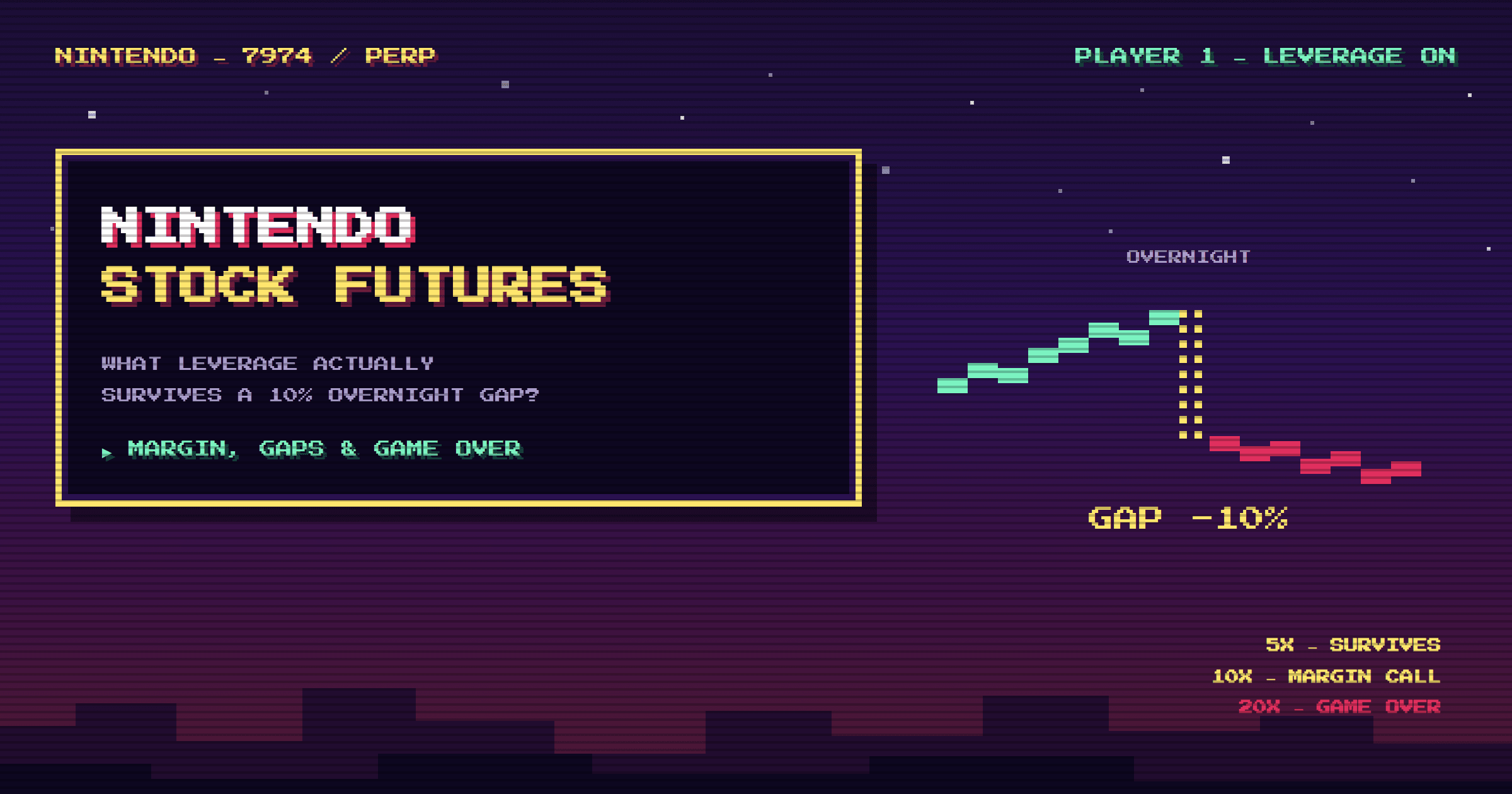
What leverage survives a 10% Nintendo gap?
Here is the arithmetic the quote pages and forecast sites never run. On an isolated-margin position, the adverse move that reaches your liquidation price is roughly one divided by your leverage, minus the maintenance margin rate. Using an illustrative 0.5% maintenance rate — tiers vary by contract and position size, so read the actual figure on the contract you trade — the buffers look like this:
- 3x: roughly a 32% adverse move. Survives everything Nintendo has done in a single session this year, and most of what it did in a month.
- 5x: roughly 19.5%. Survives a −10% day with room to spare, but not the full drawdown from ¥14,630 to ¥6,544 without adding margin.
- 10x: roughly 9.5%. The Feb 4 session alone (about −10%) closes this position. So does May 11 (−9%) if you were early by a few hours.
- 20x: roughly 4.5%. The Sep 9 session (−5.83%) is enough. So is an ordinary Tuesday in a memory-price scare.
- 50x: roughly 2%. Nintendo does 2% before lunch. This is not a trade, it is a fee.
The pattern is blunt: for a stock currently moving 5% to 10% in a day, anything above 5x is a position with a timer on it. And leverage is only half the control — the other half is collateral. Adding margin to a losing position pushes the liquidation price further away, and adjusting your margin changes your liquidation price in a way you can calculate before you enter rather than discover at 2am.
What traders usually miss: liquidation is not triggered by the closing price you see on a chart. It is triggered intra-session, on the mark price, including during hours when the Tokyo market is shut and the perpetual is thin. Lower liquidity means wider spreads, and a wick that never appears on the daily candle can still close your position permanently. Corporate actions — dividends, splits — and trading halts in the underlying add their own jumps.
Orders, TP/SL and sizing for a Nintendo stock trade
The order layer is where most of the survivable-versus-not difference is made.
- Market orders fill immediately and pay the spread. On a stock perpetual outside its home session, that spread can be materially wider than what you saw in the daytime.
- Limit orders control price and are the default for anything that is not an emergency exit.
- Trigger and stop orders get you in or out at a level, and are the mechanism for pre-positioning around a scheduled event.
- Take-profit and stop-loss should both be set at entry, before the position exists emotionally. For a name with Nintendo's move distribution, a stop placed inside 5% is a stop that will be hit by noise; if the risk you can accept is tighter than that, the answer is a smaller position, not a tighter stop.
Sizing is the part that actually decides outcomes. WEEX's own guidance is to risk no more than 1% to 2% of total capital per trade — see its risk management guide. Work backwards from that: if you can lose 2% of a $10,000 account, that is $200, and with a stop 8% away your position is $2,500 of notional, whatever leverage setting produces it. Choose the notional first, then the leverage — never the reverse.
Nintendo's next scheduled catalyst is its earnings report on Nov 2, 2026, with the holiday software slate landing in the days after. That is a known date, which means it is a date to size down into, not up.
Three ways traders position into Nintendo earnings
Three framings, in ascending order of how much conviction they require:
Hedge, not bet. If you hold Nintendo shares or the ADR through a broker and dislike the memory-cost exposure into a print, a short contract position sized to part of that holding neutralizes some downside without triggering a sale. The cost is the funding you pay and the upside you cap.
Trade the cost line, not the games. Nintendo's 2026 problem is DRAM pricing, not software quality. That makes the memory complex the real driver of the equity. A trader who thinks memory prices peak here has a Nintendo-long thesis; one who thinks AI capex keeps absorbing capacity has a Nintendo-short thesis. Either way, the thing to monitor is the supply chain, not the review scores.
Wait for the liquid instrument. If no Nintendo contract is listed where you trade, the honest answer is that the trade is unavailable — and forcing a proxy is how people lose money on a view that was actually correct. Mainstream crypto perpetuals such as BTC/USDT and ETH/USDT exist precisely because depth matters: tight spreads, deep books, predictable funding. A thin equity perpetual in an off-session is the opposite environment, and the leverage math above gets worse as liquidity thins.
Nintendo stock is a genuinely interesting asymmetry right now — a Buy consensus with an average target of ¥10,487 (about 18.6% above the ¥8,839 September level), a trailing PE near 21.6 against a forward PE near 29.8 that prices in the profit squeeze, and a company whose revenue almost doubled. But an interesting asymmetry and a survivable leveraged position are two different problems. Solve the second one before you take the first.
FAQ
1. Can you trade Nintendo stock with futures contracts?
You can trade equity perpetual contracts on a range of listed stocks, but as of Sep 10, 2026 a Nintendo (NTDOY) perpetual is not among the stock perpetuals WEEX has launched — those are US-listed names including AAPL, NVDA, COIN, MSTR, ORCL, PLTR, ABNB, MSTU, TSEM and ROK. Confirm on the live listings page before planning a trade, and never assume a contract exists because a ticker does.
2. Why did Nintendo stock drop in 2026?
Not because of sales. Memory chip prices surged as AI data centres absorbed advanced capacity, raising Switch 2 build costs. Nintendo raised the US price from $450 to $500 effective Sep 1, 2026 and guided fiscal-year operating profit to ¥370 billion against roughly ¥480 billion expected. Shares fell about 10% on Feb 4 and about 9% on May 11, 2026.
3. What is the difference between NTDOY and 7974?
7974 is the ordinary share on the Tokyo Stock Exchange, quoted in yen. NTDOY is the US over-the-counter ADR, where one receipt represents 0.25 of an ordinary share and the dollar price embeds the yen exchange rate. They track the same company but are not interchangeable prices.
4. What leverage is safe for a volatile stock like Nintendo?
There is no safe leverage, only survivable buffers. On isolated margin, your liquidation buffer is roughly 1 divided by leverage, less the maintenance margin rate — about 9.5% at 10x and about 4.5% at 20x. Nintendo has produced single sessions of 5.8%, 9% and 10% in 2026, so anything above 5x sits inside its ordinary move range.
5. Do you get Nintendo dividends from a perpetual contract?
No. A perpetual contract gives price exposure only — no share ownership, no dividend, no voting rights. Instead of a dividend you have a funding rate, paid or received periodically depending on which side of the contract is crowded.
6. What happens to a stock perpetual when the exchange is closed?
The contract keeps trading and keeps marking, on expectations rather than the cash market. Liquidity is usually thinner, spreads wider, and the reopening gap arrives in one move — which is why liquidation can occur on a wick that never shows up on the daily chart.
Risk Warning
Leveraged contracts on equities and crypto assets are high-risk instruments and can result in the partial or total loss of your margin, and losses can exceed your initial deposit in some conditions. Nintendo-specific risks compound this: the shares fell about 44% in the twelve months to Sep 9, 2026 and have produced repeated single-session moves of 6% to 10%, so a 10x position sits inside one bad day of its liquidation price. Equity perpetuals add exposures a spot crypto trader may not expect — a yen/dollar leg on any Japanese underlying, USDT settlement risk, thin off-session liquidity with wider spreads, gap risk when Tokyo reopens, funding costs that accumulate on held positions, and price jumps from corporate actions or trading halts in the underlying. Contract availability and specifications vary by region and change without notice; verify the pair, its maintenance margin tier and its funding schedule on the live trading page before entering. Nothing here is investment advice. All prices and figures are as of the dates stated.
This content is provided for general informational purposes only and doesn't constitute financial, investment, legal, or tax advice. Any events, rewards, online promotions, or related information mentioned herein should not be considered a recommendation, solicitation, or invitation to purchase, sell, trade, or otherwise deal in any crypto assets. Crypto assets are highly volatile and may result in loss. The availability of WEEX services, products, and related events may vary by region. You are responsible for ensuring that your participation is in accordance with applicable local laws and regulations.
You may also like

XST Coin Price Fell Over 40% for Two Straight Days: What That Pattern Actually Means
Federal Reserve Warning on Stock Valuations: Crypto's Real Risk

SQQQ Explained: Why the 3x Inverse Nasdaq ETF Bleeds Value

Is Micron or Sandisk a Better Buy? 2026 Memory Stock Comparison
Amazon Stock Price Prediction 2026-2030: Can AMZN Reach $600 After the AWS Acceleration?
SNDK Stock Has Crashed 50% in a Month: Is Now the Time to Trade the Volatility?

AMD Stock Price Prediction 2026-2027: Can AMD Reach $700 After the Anthropic Deal?

Samsung Stock Is 30% Below Its Peak: What Getting Back to Record Highs Actually Requires
SK Hynix Stock Before July 29 Earnings: What Investors Should Watch
SPCX Stock Price Is Down $1 Trillion From Its Peak: Is Now the Time to Buy?
ASML Stock Price Prediction 2026–2027: Can ASML Reach $2,500?
WEEX Auto Earn: How to Enable Auto Earn?
What is WEEX Auto Earn and Why It Stands Out?
Sweden Crypto Tax 2025: A Complete Guide

What is Alibaba (BABAON) Coin? A Comprehensive Guide

What is Dolomite (DOLO) Coin? A Comprehensive Guide
What is Leveraged Yield Farming? Risks and Rewards & Top Strategies
4Stock Explained: Why the Ticker Is Not the Backed Asset
GPT-6 Astra and Crypto: The AI Token Bid and the Cyber Risk
Cathie Wood Robinhood Stock: What Her 2026 Trades Really Show
Pi Network in 2026: Why Supply, Not Users, Sets PI's Price
Amazon Stock and the Plane Crash: AMZN Pricing With NYSE Shut
NVIDIA Stock: What the $108B Q3 Guide Means for NVDA Next

PONS Robinhood Chain Token: What the Buyback Rally Rests On
PEP Stock Analysis: Why PEPon Trades Above PepsiCo Shares
Cathie Wood Nvidia Stock Purchase: What ARK's August Buys Show
Micron (MU) Earnings Date: When Q4 FY2026 Reports and What to Watch
Oracle (ORCL) Earnings Date: When Q1 FY2027 Reports and What to Watch
NVIDIA (NVDA) Earnings Date: When Q2 FY2027 Reports and What to Watch
BitMEX Is Closing September 23, 2026: Timeline and How to Withdraw Before the Deadline
XST Coin Price Fell Over 40% for Two Straight Days: What That Pattern Actually Means
Federal Reserve Warning on Stock Valuations: Crypto's Real Risk
SQQQ Explained: Why the 3x Inverse Nasdaq ETF Bleeds Value
Is Micron or Sandisk a Better Buy? 2026 Memory Stock Comparison
Amazon Stock Price Prediction 2026-2030: Can AMZN Reach $600 After the AWS Acceleration?
SNDK Stock Has Crashed 50% in a Month: Is Now the Time to Trade the Volatility?


