
Suiet Wallet Shutdown: What SUI Holders Must Do Before Nov. 14

 Prefer us on Google

Suiet, a self-custodial browser wallet for Sui, stops working reliably after its API shuts down on November 14, 2026, but the shutdown does not delete or move any SUI or tokens held on the Sui blockchain. What users lose is the window into those assets: once the API is gone, Suiet may fail to show balances, sign transactions or connect to apps. The fix is to restore the same address in another Sui wallet before the deadline. This guide covers what changes on November 14, why a wallet exit is not the same as a chain failure, a step-by-step migration checklist, what Sui's falling TVL does and does not tell you, and how wallet migration differs from trading SUI spot or futures.
What the Suiet Shutdown Changes on November 14
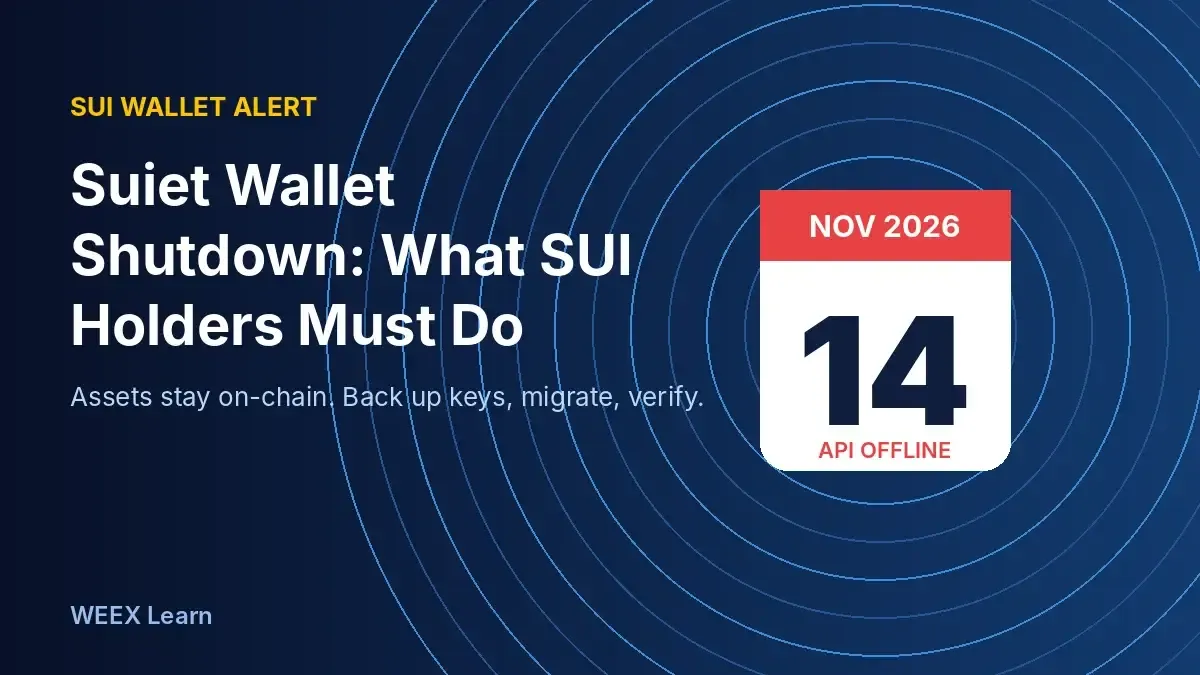
The Suiet team said it has stopped developing and maintaining the wallet and will keep its API services running until November 14, 2026, to give users time to move. Sui's official account repeated the warning on November 11 and asked users to back up the recovery phrase or private key for every account immediately.
Three practical changes follow:
- Balances and history may not load. Suiet relies on its own backend to query the chain. Without it, the extension can show empty or stale data even though nothing has changed on-chain.
- Sending and app connections may fail. Signing and broadcasting transactions, and connecting to Sui dApps, depend on the same services.
- No fallback app. Suiet never shipped a mobile app, and its Chrome Web Store listing is being removed, so there is no second Suiet client to switch to.
Suiet is also not the first exit. The Sui hardware wallet project Suiball announced its closure on November 10, and Phantom ended Sui support in September. That context matters, but it describes product teams leaving, not the Sui network malfunctioning.
Are Your SUI Assets Safe? Wallet vs. Blockchain
Yes, as long as you control the recovery phrase or private key. This is the single most misunderstood point in the Suiet story.
A self-custodial wallet does not hold coins. It stores the keys that prove you own an address, and it reads and writes to the blockchain on your behalf. Your SUI sits in that address on the Sui ledger, which is maintained by Sui's validators, not by Suiet. When Suiet's servers switch off, the ledger entry does not change. Any compatible wallet that imports your recovery phrase will derive the same address and show the same balance.
The real risk sits in two places:
- Lost recovery phrase. If you never wrote down the phrase or exported the private key, and the extension later stops opening accounts properly, recovery becomes difficult. Back it up now, offline, while Suiet still works.
- Assets inside applications. Staked SUI, liquidity positions and lending deposits live in smart contracts. They remain tied to your address, but you should check each position in the new wallet or directly in the app before you remove Suiet.
The better reading is that Suiet's closure is an operational deadline for its users, not a security incident. Nothing in the announcements points to a protocol exploit or compromised keys.
How to Migrate From Suiet Before the Deadline
Sui's official channels pointed users to migration guides for Slush, a Sui wallet that keeps the same addresses after import. Whichever wallet you choose, follow this order:
- Back up every account. In Suiet, export the recovery phrase or private key for each account. Write it on paper or another offline medium. Never paste it into a website, chat or form.
- Install the new wallet from its official source. Use the developer's own site or the verified store listing. Fake "Suiet migration" extensions and sites are the obvious scam to expect this week.
- Import, do not create. Choose the import or restore option and enter your phrase or key. Creating a new wallet gives you a new, empty address.
- Match the address character by character. Compare the full address in the new wallet with the one in Suiet. A match means the same account.
- Check balances and positions. Confirm SUI, other tokens, NFTs, staking and any DeFi deposits appear as expected.
- Send a small test transfer. Move a small amount to confirm signing works in the new wallet.
- Only then remove Suiet. Uninstall or clear the extension after everything is verified.
What traders usually miss: nobody legitimate will ask for your recovery phrase to "help migrate" your wallet. Suiet, Sui and exchange support teams do not need it. Any message, airdrop claim or pop-up that asks for it is a theft attempt.
-- Price
Sui TVL Down 22%: What the Numbers Do and Don't Say
The Suiet headlines arrived alongside weak network data. Sui's DeFi total value locked was about $413 million on November 11, down more than 22% in a month, according to DefiLlama data cited in Cointelegraph's report. Token Terminal data in the same report put Sui's October daily active users at about 128,000, versus roughly 601,000 in November 2025.
Those are external snapshots, and they measure different things:
- TVL is the dollar value of assets deposited in DeFi apps. It falls when users withdraw, but also when the SUI price falls, because many deposits are SUI-denominated. A falling TVL can be partly a price effect, not only capital flight.
- Active users counts addresses that sign transactions. It reflects participation, but one person can control many addresses, and bots can inflate or deflate the count.
- Transaction count measures activity volume. A chain can show high transaction counts driven by a few automated apps while real user numbers shrink.
Treating any one of these as "the health of Sui" is a mistake. Read together, they point to cooling DeFi activity and fewer participants over the past year. They do not show that the protocol has been compromised, and a single wallet closing does not mechanically push SUI's price in any direction. Price depends on broader market conditions, liquidity and positioning, which is where the trading picture comes in.
Wallet Migration vs. Trading SUI on WEEX
Moving SUI between self-custodial wallets and trading SUI on an exchange are different activities with different risks.
Migration is about key control: you keep custody, and the job is to restore the same address safely. Trading on a centralized exchange means the exchange holds the asset while you trade it, and the risks shift to market exposure, fees and, for derivatives, leverage.
WEEX market data at 05:32 UTC on November 12, 2026:
- SUI/USDT spot: about $0.817, down 1.23% over 24 hours, with roughly 5.25 million USDT in 24-hour volume.
- SUIUSDT perpetual: about $0.817, with about 40.35 million USDT in 24-hour volume and a funding rate near -0.0045%.
Two things stand out. Futures volume ran at nearly eight times spot volume, which means short-term SUI price moves are being driven more by leveraged positioning than by spot buying or selling. And the slightly negative funding rate means shorts were paying longs at that snapshot, a sign of mild bearish positioning rather than panic.
For readers who simply want SUI exposure, SUI spot trading on WEEX carries no liquidation risk. The SUIUSDT perpetual on WEEX allows long or short positions with leverage, which also means a move against you can liquidate the position. Headline-driven weeks like this one tend to produce sharp wicks in both directions, so leverage magnifies the cost of being early. The WEEX SUI price page tracks the live chart and market stats.
The bottom line on the Suiet wallet shutdown: back up your recovery phrase, restore the same address in another Sui wallet before November 14, verify everything, and treat migration help requests as phishing. Your SUI is on the chain, not in the extension.
FAQ
1. Will I lose my SUI if I don't migrate from Suiet by November 14?
No. Your assets stay on the Sui blockchain. You may lose convenient access through Suiet, but you can restore the address in another wallet later as long as you have the recovery phrase or private key.
2. Which wallet should Suiet users switch to?
Sui's official channels shared migration guides for Slush, and other Sui-compatible wallets also support importing a recovery phrase. Install any wallet only from its official source and confirm the restored address matches.
3. Does the Suiet shutdown mean Sui is being hacked or failing?
No. Suiet is a third-party wallet ending its service. The Sui network continues to run, and no exploit was reported in connection with the closure.
4. Is falling Sui TVL a reason SUI price must drop?
Not by itself. TVL partly tracks SUI's own price and DeFi deposits, while price reflects broader market demand and derivatives positioning. Lower TVL signals weaker DeFi activity, not a guaranteed price move.
This content is provided for general informational purposes only and doesn't constitute financial, investment, legal, or tax advice. Any events, rewards, online promotions, or related information mentioned herein should not be considered a recommendation, solicitation, or invitation to purchase, sell, trade, or otherwise deal in any crypto assets. Crypto assets are highly volatile and may result in loss. The availability of WEEX services, products, and related events may vary by region. You are responsible for ensuring that your participation is in accordance with applicable local laws and regulations.
You may also like
View moreDOJ Seeks Forfeiture of $1.1 Billion in USDC Linked to Binance Hack: What Happened?
Beginner7 minWhat Is Moonriver (MOVR)? WEEX Spot Market
Beginner3 minWhat Is SoSoValue (SOSO)? WEEX Spot Market
Beginner3 minJensen Huang Returns—and AI Stocks Explode: Can the Rally Last?
Beginner8 minWhat Is DigiByte (DGB)? WEEX Spot Market
Beginner3 minNVIDIA Rehires Jensen Huang Just 11 Days Later: What Changed Behind the Scenes?
Beginner7 minWEEX Product Guide


