
Coldcard’s $116M exploit sparks fresh clash over NVK’s defense

 Prefer us on Google


Coinkite CEO NVK has reignited debate over Coldcard's $116 million seed-generation exploit by defending its security reviews and arguing that a new AI model found a defect human reviewers missed.
Summary
- NVK says at least 15 external reviews or research efforts touched Coldcard before the defect emerged.
- Luke Dashjr disputes claims that human reviewers could not identify problems with the random-number generator.
- James O'Beirne says he raised concerns about Coldcard's randomness implementation in May 2025.
- Coinkite's current security record says a separate detailed technical postmortem remains in preparation.
NVK, posting on X on Nov. 9, said the work included reviews of Coldcard hardware, firmware, tools connected to random-number generation, and release controls. He cited two paid third-party product reviews: one covering Mk4 in 2022 and another covering Q in 2024.
At least 15 documented external review or security-research efforts touched COLDCARD hardware, firmware, RNG-adjacent tools, or release controls before the defect was discovered.
A least 2 paid third-party product reviews were completed before the incident: a Mk4 review in 2022... https://t.co/xDuFqUHEpP --- NVK (@nvk) November 9, 2026
He said Rob Ham's OpenAI Cybersecurity Harness review produced 85 candidate findings before the incident. Several prompted fixes, according to NVK, but the seed-generation defect was absent.
"The uncomfortable truth is that it took a new AI model to find what humans couldn't," he wrote.
Coldcard reviewers dispute NVK's defense
Bitcoin developer Luke Dashjr challenged the suggestion that human review could not uncover the problem, saying he had privately shared findings with Coinkite and was now disclosing them publicly.
It's been long enough, and I hear nvk is going around pretending humans couldn't find the Coldcard defect.
So public disclosure time. No clue if Coinkite fixed these after I told them privately. I'm not claiming these can all be weaponised, or that they're definitely all bugs. --- Luke Dashjr (@LukeDashjr) November 9, 2026
Dashjr cautioned that he was not claiming every issue was definitely a bug or could be exploited. He described his examination as a quick look, without a full audit or extensive time reviewing the code.
His objection focused on NVK's claim about AI: Dashjr said the assertion that only a sophisticated model could identify problems with the random-number generator was false.
Other participants questioned how Coinkite handled scrutiny. Alex Waltz accused the company and NVK of discouraging people from examining the code. Kenneth argued that ongoing quality assurance differs from asking a team to review an entire codebase.
Having a team review your entire codebase is not the same thing as having QA embedded in the process. You are looking for a needle in a haystack. Having QA involved at each step makes it much easier to find a needle in a smaller subset of hay. C'mon man. --- Kenneth (@validatedcode) November 9, 2026
Shinobi defended NVK, arguing that reviewers had examined the entropy system without identifying the defect. He challenged critics to produce a reproducible failure, saying a private message expressing concern was not equivalent to a security disclosure.
Earlier warnings remain a point of contention
James O'Beirne's older posts resurfaced in the exchange. Writing on Aug. 4, he said he began examining Coldcard's firmware in May 2025 to establish where its random-number generator obtained entropy.
O'Beirne said he questioned the use of the libngu library, raised concerns about hardcoded constants in its software fallback, and recommended linking directly against libsecp256k1.
According to his account, he was told the configuration was correct for physical devices and that a problem would already have become apparent. He acknowledged that he did not pursue the matter rigorously.
In an Aug. 5 follow-up, O'Beirne said he had received another credible account of a warning from 2021, separate from a Telegram discussion he had shared earlier. His suggestion that three people may have warned Coinkite remains his account of those communications.
I got a second credible report of someone warning Coinkite about bad entropy back in 2021, 4 years before I did. Different than the Telegram guy that I QT'd earlier.
It's possible that 3 independent people warned them about this and they neglected it every time. --- James O'Beirne (@jamesob) August 5, 2026
The $116 million estimate dates to August
TRM Labs' Aug. 5 analysis described roughly 1,816 BTC stolen from more than 5,200 addresses across four waves beginning July 30, citing Galaxy Research's running tally.
The report traced the vulnerability to a March 2021 build configuration error that selected a weak software random-number generator. On older devices, effective seed strength fell to as little as 40 bits from an intended 128, allowing attackers to reconstruct keys without physical access.
Later fund movements were reported in September. As crypto.news previously reported, Galaxy's Alex Thorn tracked a third-wave attacker swapping roughly 10% of that attacker's Bitcoin through THORChain into Ether. Most of that attacker's funds remained unmoved at the time.
An August investigation update separately described information passed to US authorities. Thorn said an attacker's identity "may be known to law enforcement"; the report did not establish a confirmed FBI identification or recovery.
-- Price
Coinkite still lists a separate postmortem as pending
Coinkite's current security page describes its published record as a living postmortem, while saying a separate detailed technical report remains in preparation.
The page distinguishes targeted independent checks from a complete audit of every corrected firmware binary. Listed work includes hardware randomness testing, source reviews, and a reproducible build.
Current recommended standard releases are 5.6.3 for Mk4/Mk5 and 1.5.3Q for Q. The advisory says firmware updates cannot repair existing affected seeds. Its migration instructions call for a new seed, a verified backup and receiving address, a small test transfer, and then movement of the remaining funds.
This content is provided for general informational purposes only and doesn't constitute financial, investment, legal, or tax advice. Any events, rewards, online promotions, or related information mentioned herein should not be considered a recommendation, solicitation, or invitation to purchase, sell, trade, or otherwise deal in any crypto assets. Crypto assets are highly volatile and may result in loss. The availability of WEEX services, products, and related events may vary by region. You are responsible for ensuring that your participation is in accordance with applicable local laws and regulations.
You may also like

[Analysis] Reasons Why This Bitcoin Decline Is Different from the Past
SBF Expresses Regret Over Anthropic Sale: AI Has a 25% Chance of Destroying Humanity, Young People Should Master AI

VIX Soars to Highest Level Since Last Year’s Tariff Turmoil, Goldman Sachs Fear Index Nears Maximum, US Stocks May Face Over $80 Billion Sell-off Next Week
Is Arthur Hayes buying the dip after moving $5M in USDC?
Bitcoin: Major Investors Return After Nine Months of Selling

Musk Regrets Spending Over $400 Million on Republican Candidates

ZRO Unlock on November 20: Why Are Supply Estimates Different?

Options Overview | AMD Sees $37.88 Million in Forward Double Call Sell, Limited Upside Ahead; Intel Shows Large Put Buys Indicating Bearish Dominance

APEC Releases Connectivity Blueprint

Institutional Withdrawal and Retail Frenzy: Why is the Eastern European Crypto Market Exhibiting 'Abnormal' Trends?
Bitcoin income ETFs promise regular payments. What do investors give up?
USD.AI Evaluates GPU Transactions at $25 Billion

Solana tokenized equities reach $1.22 billion as stock offerings expand
IoTeX adds quantum-resistant technology to developer portal
How to Choose Precious Metal ETFs? A Comprehensive Analysis of Mainstream Gold, Silver, and Mining Stock ETFs
Shiba Inu Experiences Outflow of 300 Billion SHIB from Exchanges

Hacker moves over 34279.66 ETH from Binance after inactivity
Why Are Tokenized Stocks Seeing Strong Buying Pressure While Prices Keep Falling?
XRP holders demand Ripple burn 31.1 billion tokens by March 2027
Pump.fun Launches Prediction Market Feature in Collaboration with Polymarket

ARTEX AI tool breaches networks in under 3 hours, FBI warns
Gnosis Safe wallet reportedly drained of $6.45M in suspected exploit
Thailand Stablecoin Transfer Limit: What the SEC Draft Proposes
Tesla Autopilot Team Veterans Found Simulation Startup Valued at $1 Billion
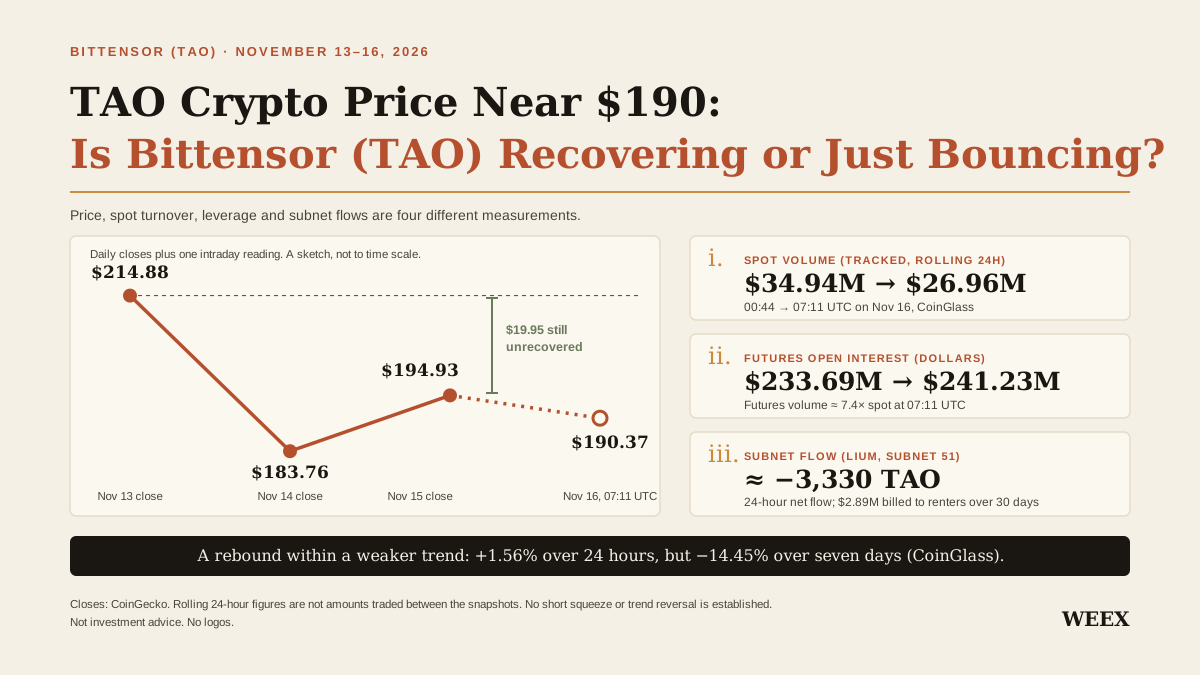
TAO Crypto Price Near $190: Is Bittensor (TAO) Recovering or Just Bouncing?
TAO bounced near $190. Compare spot volume, futures positioning, and Bittensor subnet flows to see what would confirm a more durable recovery.
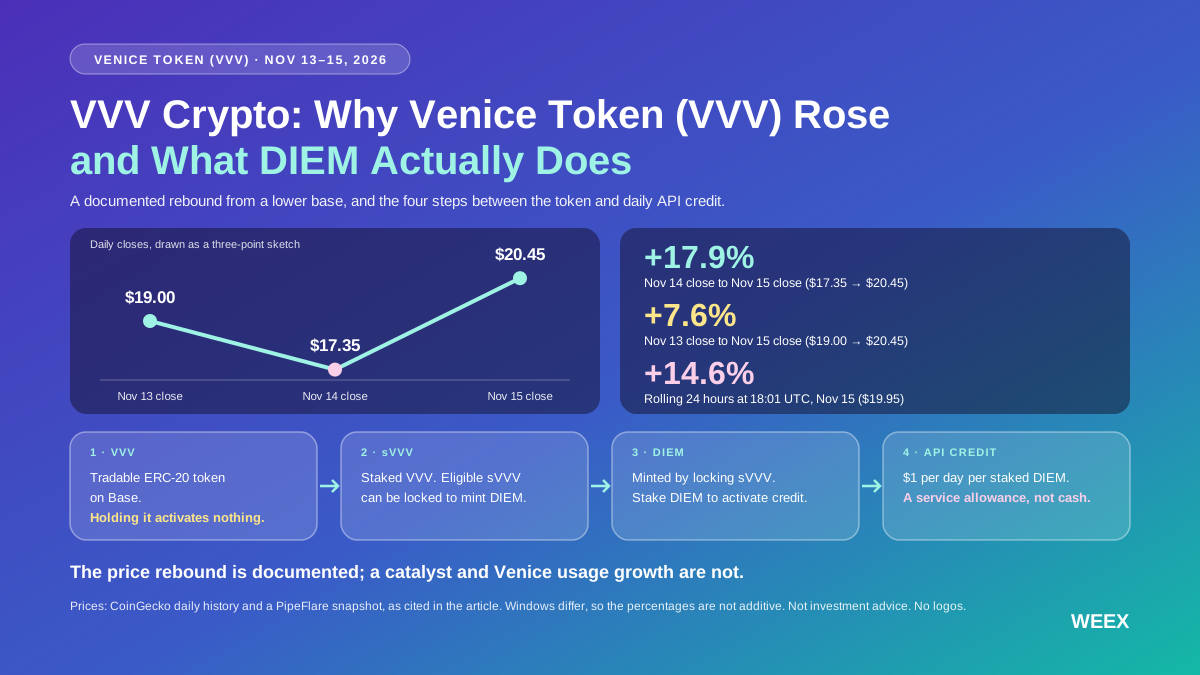
VVV Crypto: What Is Venice Token, Why Venice Token (VVV) Rose and What DIEM Actually Does
Venice Token rose about 14.6% in one November 15 snapshot. Learn what the data shows, how VVV staking works, and what DIEM’s daily API credit buys.
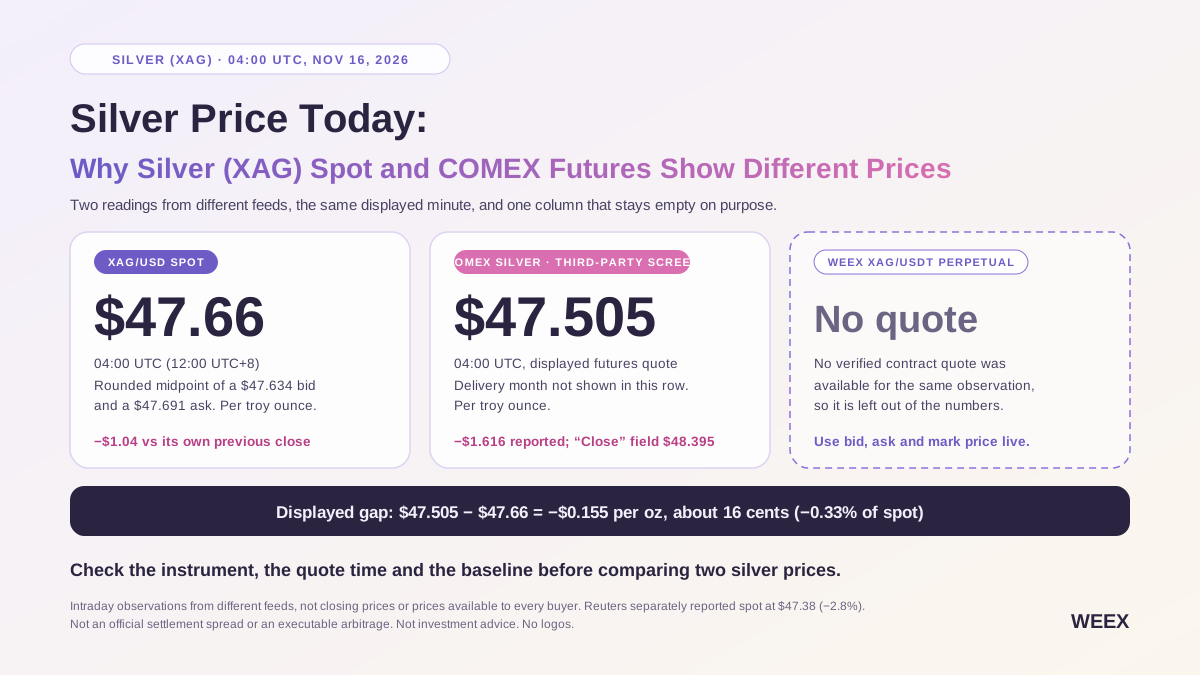
Silver Price Today: Why Silver (XAG) Spot and COMEX Futures Show Different Prices
Silver traded near $47–$48 on November 16. Compare XAG/USD spot, COMEX silver futures, and XAG/USDT perpetuals, and learn why their prices differ.

Options Big Bets | Nvidia's $118 Million Cross-Period CALL Spread Bets on Mid to Long-Term Upside; AMD's Bearish Spread Combined with Long-Term Bullish Spread, Underlying Tensions Between Bulls and Bears

Galaxy Securities: A-shares Market's Downward Risk Converges, Focus on Sector Rotation Opportunities

How $10,000 in stablecoins would have gained €420 without earning interest
[Analysis] Reasons Why This Bitcoin Decline Is Different from the Past
SBF Expresses Regret Over Anthropic Sale: AI Has a 25% Chance of Destroying Humanity, Young People Should Master AI
VIX Soars to Highest Level Since Last Year’s Tariff Turmoil, Goldman Sachs Fear Index Nears Maximum, US Stocks May Face Over $80 Billion Sell-off Next Week
Is Arthur Hayes buying the dip after moving $5M in USDC?
Bitcoin: Major Investors Return After Nine Months of Selling
Musk Regrets Spending Over $400 Million on Republican Candidates
Latest articles




Latest coin listings on WEEX


