
Huobi HTX Releases "2026 Digital Asset Trends Whitepaper": Global Liquidity Reconfiguration, Defining the New Era of "On-Chain Finance"

 Prefer us on Google


Article Source: HTX
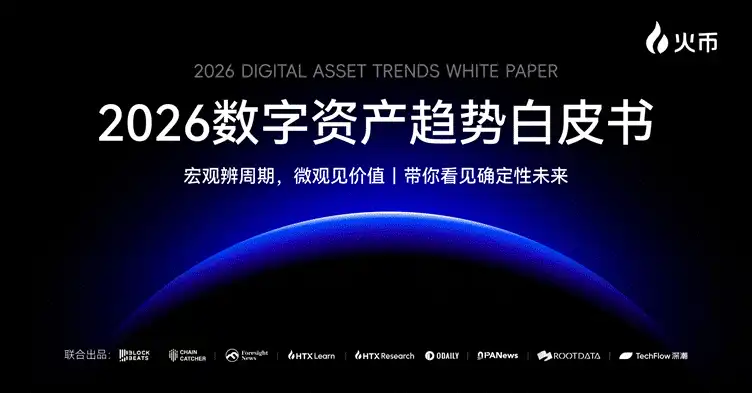
Recently, Huobi HTX officially released the "2026 Digital Asset Trends Whitepaper" (hereinafter referred to as the "Whitepaper"). This Whitepaper was jointly released by numerous industry institutions and media including BlockBeats, ChainCatcher, Foresight News, HTX Learn, HTX Research, Odaily, PANews, Rootdate, and TechFlow. In the current market downturn and cautious industry sentiment, this lengthy report, aimed at re-examining the development path of digital assets from a structural perspective, has emerged to provide forward-looking judgments and a systematic framework for the market, helping investors establish long-term confidence and cognitive anchors in an uncertain cycle.
The Whitepaper delves into an in-depth analysis of the top ten core trends in the 2026 digital asset market and points out that digital assets are completing the historic establishment of their asset class, bidding farewell to the singular "price cycle-driven" approach. They are now officially entering a new era of "structure trend-driven" and gradually transitioning from a highly volatile innovative field to a core part of the global asset allocation system. Amid this wave of global liquidity reshaping, Huobi HTX is taking a core strategic approach of "stability, transparency, institutionalization, AI empowerment," aiming to become a trusted trading and asset service infrastructure for long-term capital under the dual drive of technology and system, anchoring the direction of the new era of on-chain finance.
Macro New Landscape: From "Digital Gold" Positioning Solidification to Stablecoin Market Scale Reaching New Heights
The Whitepaper predicts that in 2026, global monetary policy will enter a "rebalancing" phase, and the interest rate differentials between the Federal Reserve and emerging markets will no longer move in sync. In this complex macro environment, BTC will solidify its "digital gold" positioning. Core assets like Bitcoin are no longer at the edge of "innovative experiments" but are deeply integrated into the global asset allocation model as structural assets, forming a hedge combination with US bonds and gold, with its pricing power further shifting towards medium to long-term capital. At the same time, ETH is expected to become the core vehicle for yield assets. With its mature staking and DeFi infrastructure, Ethereum has established its position as "on-chain national debt," becoming a cash flow-driven growth asset.
In terms of liquidity, the stablecoin market scale will reach new heights. The function of stablecoins has expanded from a simple trading medium to the infrastructure for global cross-border payments and settlements. Huobi HTX points out: "In 2026, the market is no longer asking 'whether digital assets have value' but is asking 'what percentage to allocate.'" With the stablecoin market scale surpassing 300 billion USD, a "chain-based settlement system" based on the US dollar has taken shape. Through deep cultivation of liquidity depth, Huobi HTX has become a frontline battlefield for global macro funds to gauge the market temperature.
Institutional Wave and On-Chain Asset: RWA Acceleration and Derivatives Explosion
By 2026, there has been a significant transformation in institutional entry. The institutional share will continue to rise, while retail volatility will slow down. The whitepaper summarizes the three major paths of institutional participation: direct asset allocation, yield enhancement (achieving robust cash flow through collateralization, RWA), and infrastructure participation (deeply deploying trading platforms and custodial equity in institutions). The entry of long-term funds is making market behavior more rational, and volatility is gradually converging. At the same time, the Real World Assets (RWA) scale will grow rapidly. The tokenization of US Treasuries and fixed income assets has brought a stable source of income onto the chain. Whitepaper data shows that the global RWA scale has surpassed $340 billion, with US Treasuries, gold, and even commodities such as electricity and soybeans being digitally mapped via blockchain.
With the increasing number of institutional participants, on-chain derivatives trading is expected to experience an explosion. Perpetual contracts and options products are gradually moving onto the chain, with pricing mechanisms becoming more mature. In response to this trend, Huobi HTX has fully upgraded its institutional service capabilities, building a "compliance bridge" to the on-chain world for professional capital through comprehensive API interfaces, customized risk control support, and deep integration with top global custodians, helping users lock in structural premiums amid macro fluctuations.
Infrastructure Upgrade and Rise of Intelligent Body Economy: zkEVM and AI Agent Dual-Drive
By 2026, the digital asset infrastructure is undergoing a dual-track transformation, propelling the industry into a new era of "Multi-Trillion L1" and "Automated Execution":
At the infrastructure level, Ethereum has solved 80% of the proof bottleneck through zkEVM protocol-level integration, entering the "Multi-Trillion L1" era, integrating ecosystem liquidity with ultimate performance and security, completely ending the narrative of the "Ethereum killer." In this context, modular blockchain will become the mainstream architecture. As underlying protocols are commoditized, value is shifting at scale from the protocol layer to "fat applications," and the L2 driven by super dApps and AI Agent economy will become the ecosystem core.
At the same time, AI Agent will become the on-chain execution entity. AI agents are replacing humans as the core of trading, revenue management, and risk control. As of March 2026, the economic output generated by AI Agents (aGDP) has reached hundreds of millions of dollars. The trading mode is transitioning from "manual operation" to "intent-driven," heralding the rise of the intelligent body economy.
Huobi HTX is at the forefront of technology and has launched HTX AI Skills. Users only need to input natural language, and AI can complete market analysis, strategy generation, and assist in execution. This "intent-driven" trading new paradigm greatly reduces the threshold, allowing ordinary investors to enjoy professional and intelligent on-chain financial services.
-- Price
Embracing 2026, Huobi HTX's strategic foundation is transparent competition and regulatory certainty
In an era of structural differentiation, competition between platforms has shifted from traffic competition to "trust competition." Transparent competition will become the core difference of trading platforms. In its whitepaper, Huobi HTX emphasizes that transparency is no longer just an added bonus but a survival baseline. Huobi HTX has taken the lead in the industry to implement "Proof of Reserves (PoR) normalization," achieving asset transparency and verifiability through technical means. At the same time, as regulation gradually becomes clearer, the gray areas will narrow further. In the year 2026 when global regulation tends to be clear, the compliant operation of Huobi HTX is demonstrating strong risk resilience.
Huobi HTX promises to its global users: Security and transparency are the foundation of platform development. In the future, Huobi HTX will focus its strategic layout on three main lines: continuously upgrading institutional service capabilities, integrating on-chain assets and yield products, and advancing global compliance layout.
As stated in the conclusion of the whitepaper: the digital asset market is transitioning from "comprehensive bull market" to "survival of the fittest," marking an era for professionals and long-term strategists. In 2026, Huobi HTX introduced the four key strategic keywords of "stability, transparency, institutionalization, AI empowerment," aiming to not only be a trade matcher but also a builder of on-chain financial infrastructure. In the grand narrative of liquidity reconstruction, Huobi HTX is willing to join global participants in ushering in the next golden decade of digital assets.
About Huobi HTX
Huobi HTX was founded in 2013 and has developed over 12 years from a cryptocurrency exchange to a comprehensive blockchain business ecosystem, covering digital asset trading, financial derivatives, research, investment, incubation, and other businesses.
As a leading global Web3 portal, Huobi HTX adheres to a development strategy of global expansion, ecosystem prosperity, wealth effect, and security compliance, providing comprehensive, secure, and reliable value and services to cryptocurrency enthusiasts worldwide.
This content is provided for general informational purposes only and doesn't constitute financial, investment, legal, or tax advice. Any events, rewards, online promotions, or related information mentioned herein should not be considered a recommendation, solicitation, or invitation to purchase, sell, trade, or otherwise deal in any crypto assets. Crypto assets are highly volatile and may result in loss. The availability of WEEX services, products, and related events may vary by region. You are responsible for ensuring that your participation is in accordance with applicable local laws and regulations.
You may also like

Canary Capital Launches First Spot TRX ETF with Staking in the U.S.

Arc Public Mainnet Launches on September 16, Fees in USDC

SGX Receives CFTC Approval to Offer Bitcoin and Ethereum Perpetual Futures to U.S. Institutions

South Korean court rules Ethereum is an information network

Fidelity brings FIDD stablecoin to on-chain finance
Ethereum Spot ETF Sees Net Inflow of $34.75 Million Yesterday, BlackRock's ETHB Leads

WEEX Exclusive:Oil Back Above $100 | WEEX TradFi Daily (September 10, 2026)
What is Starknet? Reasons for the Supply Cap of 10 Billion in Published Information

Oil Back Above $100 | WEEX TradFi Daily (September 10, 2026)
On September 10, markets digested Apple’s product event and the oil breakout. Apple (AAPL) launched its first foldable iPhone Duo at $1,999, while the iPhone 18 Pro price rose by $100 to start at $1,199. The stock closed down about 0.3% at $315.34 on September 9 ET. Brent crude moved back above $100, all three major U.S. indexes closed lower, and energy was the only sector to post a gain of about 1.1%. Bitcoin remained capped by renewed hike pricing. Investors are now waiting for Adobe (ADBE) and Oracle (ORCL) earnings after the close on September 10 ET.
Ethereum to Allow Gas Fee Payments Without Holding ETH, Considered for 2027 Upgrade

Bitrace: High-Risk Addresses Collected $50.21 Billion in Illegal Funds in 2025

US Invests $300 Million to Support Quantum Hardware, Accelerating Quantum Resistance Upgrades for Bitcoin and Ethereum

Stablecoin Supply Nears $290 Billion, Annual Transactions Exceed $90 Trillion
U.S. Department of Commerce Allocates Up to $100 Million to Three Quantum Computing Companies
Trezor Activates Clear Signing for Ethereum Transactions

Blockchain Speed Is No Longer the Main Criterion for Blockchain Quality, According to Andreessen Horowitz

US Sanctions Chinese Network Laundering Billions in Crypto
Crypto Depository Will Open Accounts Only with Tax Identification Number
Vitalik Proposes Recursive STARK Memory Pool to Reduce Quantum-Safe Signature Costs
Coinbase Initiates Discussions on Bitcoin Quantum Security
Everclear Allocates $300,000 Treasury Funds to Token Holders

Brazil’s Tokenization Push Accelerates With $2 Billion Credit Plan
Coinbase Hosts Post-Quantum Bitcoin Seminar to Discuss Asset Migration Solutions
Crypto: Ethereum Reserves Drop to 14.88 Million ETH
200 Million Penguins Burned, Valued at $160,000
Bitcoin Collateral Loans: Utilizing Wrapped Tokens

You can borrow against Bitcoin without selling it, but there’s a catch
Consensys Spins Off MetaMask as Independent Entity, Joe Lubin Appointed CEO
[Kwon Seong-min Column] Does an IPO Become an ICO When It Goes On-Chain?

Online Casinos Outside of Oasis: Safe Alternatives for Players from Germany 2024 - Bitcoin News
Canary Capital Launches First Spot TRX ETF with Staking in the U.S.
Arc Public Mainnet Launches on September 16, Fees in USDC
SGX Receives CFTC Approval to Offer Bitcoin and Ethereum Perpetual Futures to U.S. Institutions
South Korean court rules Ethereum is an information network
Fidelity brings FIDD stablecoin to on-chain finance
Ethereum Spot ETF Sees Net Inflow of $34.75 Million Yesterday, BlackRock's ETHB Leads
Contents
Latest articles





Latest coin listings on WEEX


