
Why Is Bitcoin Reacting to the September 2026 Fed Rate Hike?

 Prefer us on Google


Bitcoin is reacting to the September 2026 Federal Reserve rate hike because higher U.S. interest rates strengthen the dollar, raise bond yields, tighten financial conditions, and make speculative assets less attractive at the margin. However, Bitcoin did not collapse after the September 16 decision because the 25-basis-point increase was already widely expected. BTC instead traded around $75,000–$76,700 as investors shifted their attention from the hike itself to the risk of additional tightening later in 2026.
In our view, the relatively muted Bitcoin reaction is more important than the rate increase. A first Fed hike since 2023 should have been an obvious bearish shock, yet BTC absorbed it without a disorderly sell-off. That does not make the decision bullish. It suggests the market had already priced in the headline and is now waiting for harder evidence about inflation, liquidity, and the Fed’s next move. Treating every rate hike as an automatic Bitcoin crash signal is lazy analysis; the gap between expectations and reality matters more than the announcement alone.
Quick Read
- The Fed raised its target rate by 25 basis points to 3.75%–4.00% on September 16, 2026.
- The unanimous decision marked the first U.S. rate increase since 2023.
- Bitcoin remained near $75,000–$76,700 rather than experiencing an immediate collapse.
- The hike had already been widely anticipated, limiting the surprise.
- A stronger dollar, rising Treasury yields, and expectations of another hike remain the main risks for BTC.
- Future inflation and liquidity data are now more important than the September decision itself.
What Did the Federal Reserve Decide in September 2026?
The Federal Open Market Committee raised the federal funds rate target by 25 basis points on September 16, moving it from 3.50%–3.75% to 3.75%–4.00%.
The decision followed the FOMC’s September 15–16 meeting and was approved unanimously by a 12–0 vote. The official statement was released at 2:00 p.m. Eastern Time.
The increase was the first U.S. rate hike since 2023. It also reversed the expectation that the Fed might continue holding rates steady after its July 2026 meeting.
The Federal Reserve cited its dual mandate when announcing the decision. Chair Kevin Warsh subsequently emphasized that inflation had remained too high and that underlying price pressure was not falling quickly enough.
The Fed’s accompanying implementation notice also raised:
- The interest rate paid on reserve balances to 3.90%.
- The primary credit rate to 4.00%.
- The new operational rates effective September 17, 2026.
Those changes matter because the federal funds rate is not merely a headline number. It influences short-term borrowing costs, bank funding, Treasury yields, currency markets, corporate financing, and investors’ willingness to take risk.
How Did Bitcoin React to the Fed Rate Hike?
Bitcoin’s reaction was volatile but not catastrophic.
After the decision, BTC continued trading broadly between approximately $75,000 and $76,700. Market data observed on September 17 placed Bitcoin near $76,400, with an intraday range of roughly $75,200–$76,700.
That price behavior shows that Bitcoin did not respond to the rate hike with a simple one-direction sell-off. The market had already spent several days adjusting to a likely increase.
Before the meeting, interest-rate markets assigned a high probability to a 25-basis-point hike. A Reuters survey conducted shortly before the decision found that 86 of 101 economists expected the Fed to raise rates to 3.75%–4.00%.
When a policy decision is widely anticipated, traders often reposition before the official announcement. The price reaction afterward therefore depends on whether the decision and press conference are more hawkish or dovish than expected.
In this case, the 25-basis-point increase itself was not the main surprise. The greater concern was the possibility that the Fed could raise rates again before the end of 2026.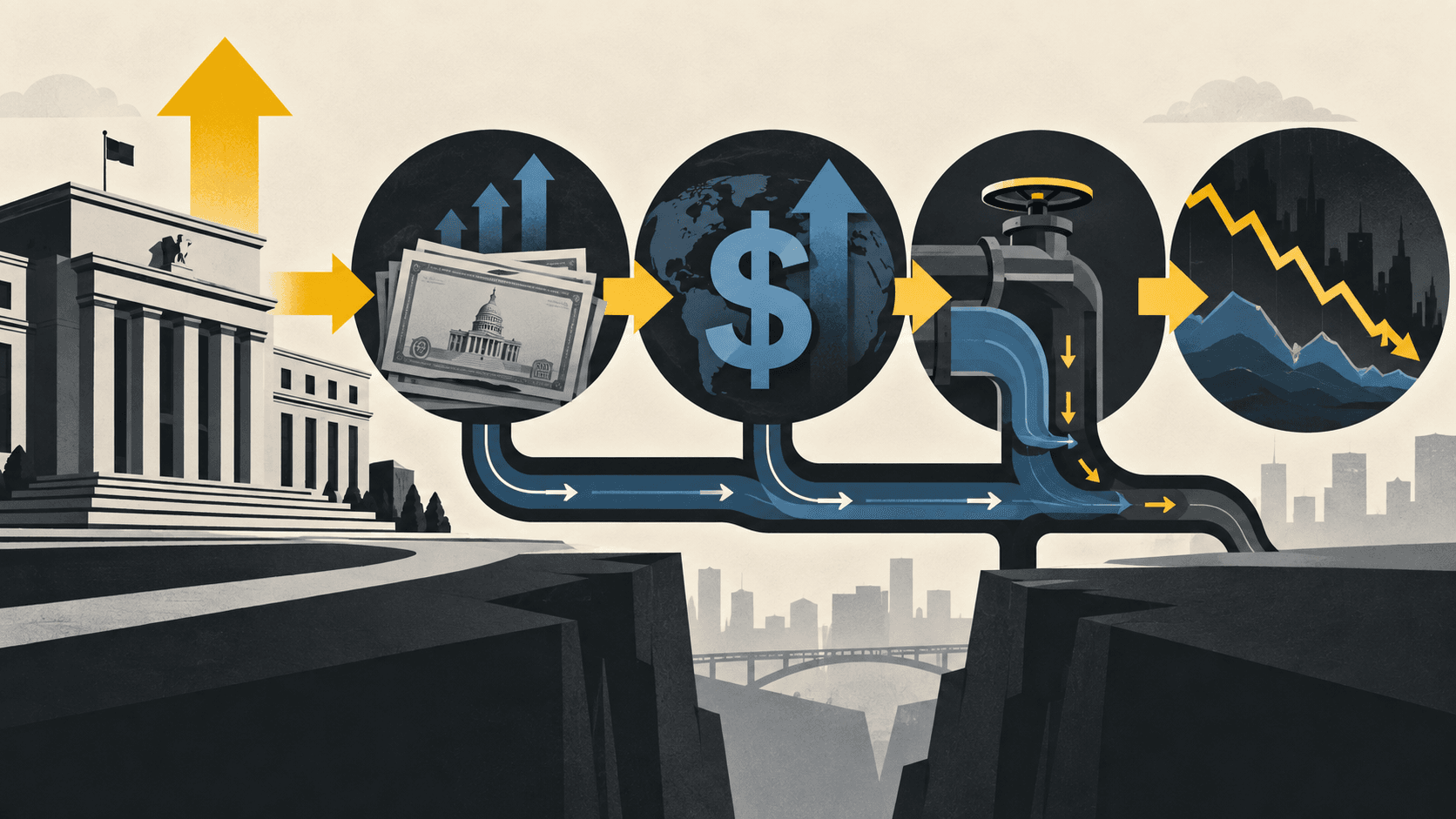
-- Price
Why Do Higher Interest Rates Affect Bitcoin?
Bitcoin is not issued by a central bank and does not pay interest, but it trades inside a global financial system dominated by dollars, government bonds, credit, and institutional liquidity.
That creates several transmission channels between Federal Reserve policy and BTC.
Higher Treasury Yields Increase the Cost of Holding Risk
When government bond yields rise, investors can earn a higher return from assets generally viewed as carrying less risk than cryptocurrency.
Bitcoin must then compete with Treasury bills, money-market funds, and interest-bearing deposits for capital. It does not need to offer a direct yield, but investors require a stronger reason to accept its volatility when cash-like instruments are paying more.
This does not mean money automatically leaves Bitcoin whenever yields rise. It means the opportunity cost of holding BTC becomes less favorable.
A Stronger Dollar Can Pressure Bitcoin
The U.S. dollar strengthened after the September Fed decision, with the dollar index reaching a seven-week high according to Reuters.
Bitcoin is commonly priced in dollars. A stronger dollar can reduce demand from non-U.S. buyers because purchasing the same amount of BTC becomes more expensive in local-currency terms.
Dollar strength also tends to coincide with tighter global financial conditions. Emerging-market currencies, commodities, equities, and crypto assets can all face pressure when investors move toward dollar-denominated assets.
Higher Rates Tighten Market Liquidity
Cryptocurrency performs best when capital is abundant, borrowing is relatively cheap, and investors are willing to move further along the risk curve.
Higher interest rates work in the opposite direction. They increase financing costs, reduce leverage, slow credit creation, and encourage investors to keep more money in cash or short-duration bonds.
Bitcoin has a fixed monetary supply schedule, but its market price still depends on the amount of capital available to buy it. Scarcity does not eliminate liquidity risk.
Leverage Can Amplify the Initial Move
Crypto derivatives allow traders to build large positions using borrowed capital. When a macroeconomic announcement causes BTC to move quickly, leveraged positions may be liquidated.
Those liquidations can turn a modest decline into a faster sell-off. The same process can work in reverse when short positions are forced to close.
For this reason, the first few minutes after an FOMC decision can produce exaggerated price movements that do not represent the market’s settled interpretation.
Why Didn’t Bitcoin Fall More Sharply?
The simplest answer is that the hike was largely priced in.
A market does not wait for an official announcement before reacting. It responds as expectations change. By the time the Fed confirmed its September increase, traders had already adjusted positions based on inflation data, economist forecasts, futures pricing, and Fed commentary.
Three additional factors helped limit the immediate reaction.
The Fed Delivered the Expected 25-Basis-Point Move
A larger 50-basis-point increase would have produced a much stronger shock. Instead, the Fed chose the outcome most investors expected.
The absence of a bigger surprise reduced the need for rapid repricing.
Bitcoin Had Already Absorbed Other Negative News
The crypto market entered the Fed meeting after the Senate failed to advance the CLARITY Act on September 15.
That separate political setback had already pressured Bitcoin and crypto-related shares. Some regulatory disappointment may therefore have been reflected in BTC before the Fed announced its decision.
Traders Are Distinguishing One Hike From a Full Tightening Cycle
One 25-basis-point increase changes financial conditions, but it does not automatically establish a long sequence of future hikes.
Bitcoin traders are now attempting to determine whether September was an isolated adjustment or the beginning of a more sustained tightening cycle. Until that question becomes clearer, the market may remain volatile without committing to a durable direction.
The September Hike Versus Bitcoin’s Initial Reaction
| Indicator | Before the Decision | After the Decision | Why It Matters |
|---|---|---|---|
| Federal funds target | 3.50%–3.75% | 3.75%–4.00% | Higher short-term borrowing costs |
| FOMC vote | Decision pending | Unanimous 12–0 approval | Shows broad support inside the Fed |
| Bitcoin price area | Mid-$70,000 range | Approximately $75,000–$76,700 | No immediate disorderly sell-off |
| U.S. dollar | Already firm | Rose to a seven-week high | Stronger dollar can pressure global risk assets |
| Two-year Treasury yield | Rising ahead of meeting | Reached approximately 4.72% | Reflects expectations for tighter monetary policy |
| Market focus | Whether the Fed would hike | Whether another hike will follow | Forward expectations now matter more |
Bitcoin and market figures reflect observations available through September 17, 2026. Prices vary by exchange and change continuously.
Is a Fed Rate Hike Always Bearish for Bitcoin?
Not necessarily.
The direction of Bitcoin after a Fed decision depends on at least four variables:
- What the market expected before the announcement.
- What the Fed actually decided.
- What policymakers signaled about future meetings.
- How much leverage was already positioned in one direction.
A rate hike can coincide with a Bitcoin rebound if traders expected something more aggressive. A rate hold can still trigger a decline if the Fed warns that future increases are likely.
This is why “rates up equals Bitcoin down” is an incomplete framework. Bitcoin responds to changes in expected liquidity, not merely the current policy rate.
Historical comparisons also require caution. Bitcoin’s ownership structure, institutional participation, ETF exposure, derivatives market, and sensitivity to macroeconomic news have changed over time. A reaction observed in one policy cycle may not repeat under different market conditions.
What Should Bitcoin Traders Watch Next?
The September rate decision is complete. The next phase depends on incoming data and how those figures change expectations for future Fed policy.
U.S. Inflation Data
Consumer Price Index and Personal Consumption Expenditures data will be central to the next rate debate.
If underlying inflation remains elevated, markets may price in another increase. A convincing decline in inflation would reduce the pressure for additional tightening.
Traders should distinguish headline inflation from core measures. Energy prices can cause large short-term changes, while the Fed may focus more heavily on persistent service and underlying price pressure.
Treasury Yields
Short-duration Treasury yields reflect expectations for Federal Reserve policy.
If the two-year yield continues climbing, it would suggest that investors expect rates to remain higher or rise again. That environment is generally more challenging for speculative assets.
Falling yields could provide relief, particularly if they decline because inflation expectations are improving rather than because the economy is entering a severe downturn.
The U.S. Dollar Index
Continued dollar strength would tighten conditions for global markets and could restrict Bitcoin’s upside.
A weaker dollar would remove one macroeconomic headwind, although it would not guarantee that BTC prices rise.
Oil and Energy Prices
Energy prices played an important role in the September inflation debate. A renewed oil surge could increase headline inflation and make another Fed hike more likely.
Lower energy prices would reduce some of that pressure, especially if broader inflation measures also soften.
ETF and Spot-Market Flows
Macroeconomic conditions explain the wider risk environment, but actual Bitcoin demand still matters.
Traders should compare price movements with spot volume, exchange-traded fund flows, derivatives funding rates, open interest, and liquidation data. A price increase driven by spot demand is usually more durable than one caused primarily by leveraged short covering.

What Does the Rate Hike Mean for Long-Term Bitcoin Investors?
Long-term holders should not ignore the Fed, but they should also avoid treating a single meeting as a complete investment thesis.
Higher rates can pressure Bitcoin valuations and reduce speculative demand. That is a real risk, particularly if tightening continues or causes broader financial stress.
However, Bitcoin’s longer-term market direction also depends on:
- Institutional demand.
- Regulatory treatment.
- ETF and corporate treasury flows.
- Network adoption.
- Market liquidity.
- Global confidence in fiat currencies and government debt.
- The broader crypto market cycle.
The September hike changes the macroeconomic environment. It does not alter Bitcoin’s supply schedule, reverse completed network transactions, or determine every source of future demand.
Investors following BTC through WEEX or another trading platform should therefore separate three time horizons: the immediate reaction to the FOMC announcement, the medium-term effect of tighter liquidity, and the longer-term demand for Bitcoin as an asset.
FAQ
How Much Did the Fed Raise Interest Rates in September 2026?
The Federal Reserve raised its target range by 25 basis points, from 3.50%–3.75% to 3.75%–4.00%, on September 16, 2026.
What Time Was the September 2026 Fed Decision Released?
The FOMC statement was released at 2:00 p.m. Eastern Time on September 16, 2026.
Why Did Bitcoin Not Crash After the Rate Hike?
The hike was widely expected and had already been partially priced into the market. Investors were more focused on the Fed’s future policy path than on the anticipated 25-basis-point move itself.
Could Another Fed Rate Hike Push Bitcoin Lower?
Yes. Another hike could pressure BTC by strengthening the dollar, raising bond yields, and tightening liquidity. The actual reaction would still depend on whether the increase had already been priced in.
What Economic Data Matters Most for Bitcoin Now?
Inflation figures, labor-market data, Treasury yields, the U.S. dollar, energy prices, and Bitcoin spot or ETF flows are among the most important indicators.
WEEX Editorial View: Bitcoin’s Resilience Should Not Be Mistaken for Safety
Bitcoin’s ability to absorb the first U.S. rate hike since 2023 is a sign of market resilience, but traders should not turn that resilience into a bullish fantasy. The Fed has made money more expensive, the dollar has strengthened, and short-term Treasury yields have risen. Those are genuine constraints on speculative demand.
The strongest conclusion is that the market correctly anticipated the September move—not that Bitcoin has become immune to monetary policy. If inflation stays elevated and the Fed delivers another increase, BTC will face a more difficult test because the surprise will no longer be limited to a single, well-telegraphed decision.
At the same time, the lack of an immediate collapse challenges the simplistic claim that every rate hike must destroy Bitcoin’s price. Markets trade the difference between what was feared and what actually happened. The September decision was hawkish, but it was not unexpected.
The mistake now would be to obsess over the completed 25-basis-point hike while ignoring the data that determines what comes next. The direction of inflation, the dollar, bond yields, and real spot demand will tell traders far more about Bitcoin’s next major move than the September headline alone.
Sources
- Federal Reserve, “Federal Reserve Issues FOMC Statement,” released September 16, 2026 at 2:00 p.m. EDT:
https://www.federalreserve.gov/newsevents/pressreleases/monetary20260916a.htm - Federal Reserve, “Implementation Note Issued September 16, 2026”:
https://www.federalreserve.gov/newsevents/pressreleases/monetary20260916a1.htm - Reuters, “Bitcoin’s Late-Summer Rally Set to Face Off Against the Fed, Congress,” published September 14, 2026:
https://www.reuters.com/business/finance/bitcoins-late-summer-rally-set-face-off-against-fed-congress-2026-09-14/ - Reuters, “Hawkish Fed Lifts Dollar to Seven-Week High,” published September 17, 2026:
https://www.reuters.com/world/asia-pacific/hawkish-fed-lifts-dollar-seven-week-high-focus-turn-boj-2026-09-17/
This content is provided for general informational purposes only and doesn't constitute financial, investment, legal, or tax advice. Any events, rewards, online promotions, or related information mentioned herein should not be considered a recommendation, solicitation, or invitation to purchase, sell, trade, or otherwise deal in any crypto assets. Crypto assets are highly volatile and may result in loss. The availability of WEEX services, products, and related events may vary by region. You are responsible for ensuring that your participation is in accordance with applicable local laws and regulations.
You may also like

Crypto Futures on Moscow Exchange: Already 600 Billion Rubles Traded

The Fed Hikes Rates 25 Basis Points to 3.75%–4% — Here's What It Means for Bitcoin's Next Move
Kevin Warsh's inflation warning, a more hawkish dot plot, and three roads ahead for crypto

Fed Rate Hike 2026: Can Bitcoin Hold $75K as Gold Stays Strong?

The Quantum Issue: To Freeze Coins Or Not

Avalanche: From Digital Identity in the UAE to Finance in South Korea

Prometheum, HashKey, and Velocity Sign MOU to Promote Tokenized US Stocks
Core Lightning Vulnerability Risk, Experimental Features Recommended to be Disabled

Can 龙虾 Coin Reach $0.25 After Its 100x WEEX Rally?
Bitcoin and Ethereum ETF Outflows in September 2026: Are Investors Starting to Withdraw Funds? - Fintech World

Can BTC Hold $75K After the Clarity Act Failure?
MSFT Stock Falls as AI Slowdown Fears Return: Is Microsoft's AI Growth Actually at Risk?

MU Stock Faces a New Risk: Could a Taiwan Strike Disrupt the AI Memory Boom?

U.S. Senate Discusses Requirement for AI Companies to Fulfill Duty of Care

Bitcoin Gains Strength, but CryptoQuant Detects Weakness in the Market

Bitcoin exchanges can reduce quantum exposure before a network upgrade

After the Fed, the Bank of Japan is also expected to raise its rates: what are the consequences for cryptos?
![[Editorial] Everyone Predicts, but 0.1% Take All the Money](/public-static/16_c530d6305c.png?format=avif)
[Editorial] Everyone Predicts, but 0.1% Take All the Money

MU Stock Falls on AI Slowdown Fears: Is HBM Demand Actually Slowing?
NVDA Stock Price Prediction 2026: Can Nvidia Reach $300?
ZEC Price Prediction After $1,000 Breakout: Is $1,500 Next?
ByteDance Syndicated Loan: Demand for $30 Billion Against $20 Billion Requested

Which Crypto Apps Offer Real-Money Rewards? Win iPhone Duo on WEEX in Sep 2026

How Cryptocurrency Owners Lose Fortunes Due to One Mistake in the Blockchain

Bitcoin: Goldman Sachs Changes Its View on Fed Rates
AI Agent Payments: How Far Has Korea Come?
ChatGPT Serves Criminals: Crypto Investor Lost $2,100,000 After Chatbot's Advice
Hardware Wallets Do Not Provide Unbreakable Security for Crypto
Ethereum EIP-8141 Proposes Transaction Fee Payment Structure Without ETH
Oracle Stock Price: Record Cloud Revenue Growth of 121% Sent ORCL Surging After Earnings
Mr&强 Launches WEEX AI Wars II Event with Rewards for Participants
Crypto Futures on Moscow Exchange: Already 600 Billion Rubles Traded
The Fed Hikes Rates 25 Basis Points to 3.75%–4% — Here's What It Means for Bitcoin's Next Move
Kevin Warsh's inflation warning, a more hawkish dot plot, and three roads ahead for crypto
Fed Rate Hike 2026: Can Bitcoin Hold $75K as Gold Stays Strong?
The Quantum Issue: To Freeze Coins Or Not
Avalanche: From Digital Identity in the UAE to Finance in South Korea
Prometheum, HashKey, and Velocity Sign MOU to Promote Tokenized US Stocks





